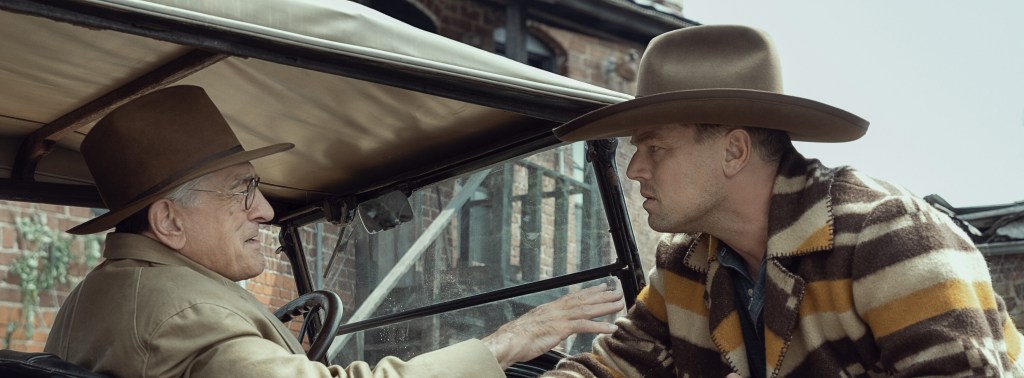
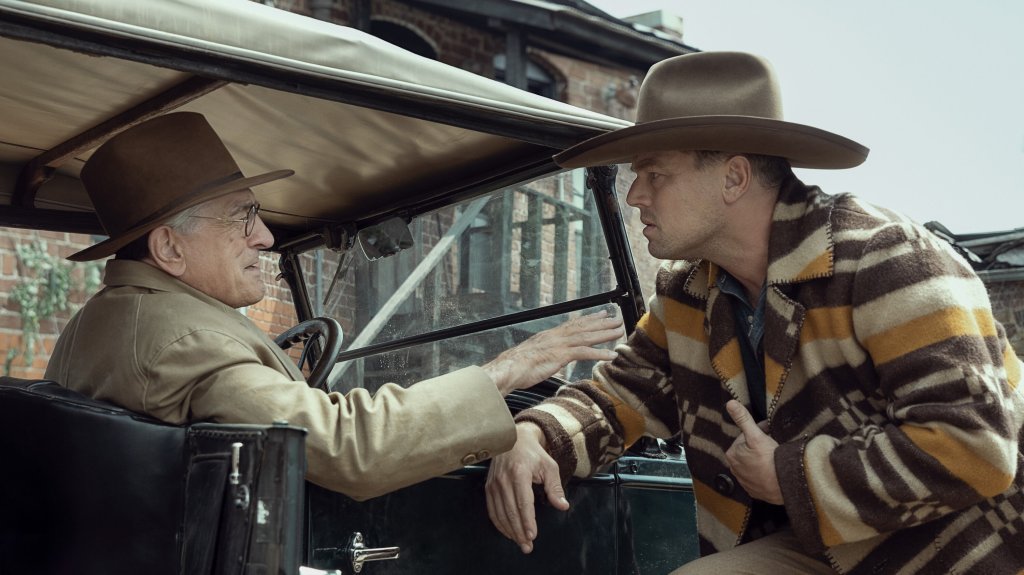
Throughout the course of his career, Martin Scorsese has had a keen interest in exploring the depths and complications of American culture and what our country runs off of and is built on – The Wolf of Wall Street especially was an in-depth look into how greed poisons our institutions and the so-called “American dream” that so many chase is a hollow shell of corruption. However, when it comes to Killers of the Flower Moon, I think Scorsese has made a pretty definitive final word on his saga of American greed; taking us back to the 1920s in Oklahoma under Osage Nation land – we see the true depths of American greed and corruption in a story about how a handful of people were responsible for a wide-spread string of serial killings of Native Americans. Greed is a fundamental word when it comes to describing America, but one of the biggest cornerstones of American history is how much we’ve taken from Native Americans and erased their history – this is a story, among other things, about that violent, disturbing erasure that spawns from American greed.
Earlier this summer I had the privilege to readKillers of the Flower Moon, the harrowing novel by David Grann which this film is based off of. As I was reading it and was stunned by how sprawling and intricate the real-life story became, I questioned how Scorsese would fit so much of it into a single-film, even with the whopping 206-minute running-time; making this a true epic in every sense of the word. It has a star-studded cast, a large array of characters and relationships that it intertwines, a ton of American history that it covers over the course of several years, and especially has a lot to get off its chest about this time in American history and how it influences our world today. And yet, even with all of these factors at play, Scorsese wisely takes a different approach when adapting Grann’s novel – where Grann’s novel was about the killings as a whole and had a sprawling look at how it formed the FBI into what we know it as today, Scorsese’s film is tightly focused on three central people: William Hale (Robert DeNiro), Ernest Burkhart (Leonardo DiCaprio) and Mollie Burkhart (Lily Gladstone) and their relation to these murders.
While every performance here is incredible, it’s really the central core of DeNiro, DiCaprio, and Gladstone that blew me away. DeNiro is obviously a legend in the industry with a countless amount of iconic performances, but his sheer screen-presence and portrayal of a personification of American greed and the evil that it spawns is haunting. DiCaprio as well is an actor who, while much younger than Deniro, has just as many iconic performances under his belt – yet it feels like he has never played a role quite like that of Ernest Burkhart; a man void of any self-control and completely thrives off of his service to others, despite being largely incompetent and not very smart. DiCaprio wisely and simultaneously brings a sense of humanity to a man who has done awful things, as well as showcasing just how incompetent he was. It’s a tricky line to walk, but he does it gracefully, turning in one of his best performances in years.
However, Lily Gladstone is the true star of the film for my money, as she quietly becomes the emotional core of the film. Mollie Burkhart is a victim of so many different crimes and atrocities at the hand of people she trusted most, but both Gladstone and Scorsese wisely never depict her as just a victim. Gladstone gives a stoic, mesmerizing yet reserved performance that may just win her an Oscar. There are several moments with her that are just truly, quietly devastating in a profound way. Her chemistry with Leonardo DiCaprio and how they depict Mollie and Ernest’s marriage is one of the most tragic and fascinating aspects of the film.
From a filmmaking perspective, it feels so inevitable and frankly almost pointless to say that “Martin Scorsese did a fantastic job directing this film!” – but in comparison to his truly illustrious career, this is some truly top-shelf work even for his standards. He packs so much of this film to the brim with American history, intertwining its themes and characters together seamlessly. Another large reason why the film works as well as it does is due to Scorsese’s long-time editor Thelma Schoonmaker who gives this 206-minute epic a true rhythm and pace to it; there’s truly never a jumping off point in its large running time, and asks you to fully invest your time and attention for the entire duration – proving itself to be worthy of that time and attention every second you spend with it.
Another big compliment to serve Killers of the Flower Moon is how gorgeous it looks and how stunning the cinematography is at every turn. This is the very first note I took from the film from its opening frame that truly had my jaw dropped. Cinematographer Rodrigo Prieto, who turned in equally fantastic work in Martin Scorsese’s 2016 film Silence, has truly outdone himself here. There’s a certain sequence somewhere towards the third act of the film involving fire at nighttime that truly blew me away and may just end up being the shot to beat this year. All of these technical components, and inclusion to the ones that I haven’t mentioned like the brilliant sound design, the fantastic score from the late-great Robbie Robertson, etc. make this such a well-rounded, full-fledged masterpiece to the fullest degree.
Martin Scorsese has talked a lot about retirement and slowing down over the course of his press tour with Killers of the Flower Moon, and I definitely understand it. At the age of 80, he has graced us with a plethora of masterpieces that have defined and influenced cinema so greatly over the course of 50-years. However, with Killers of the Flower Moon, Scorsese once again proves just how masterfully he can craft a film – he reminds us of the power of storytelling, and within this particular story, he makes some reflections on the importance of who is telling those stories and how we choose to tell them. A downright masterpiece from our greatest living director.
5/5

 Films for Breakfast
Leave a comment