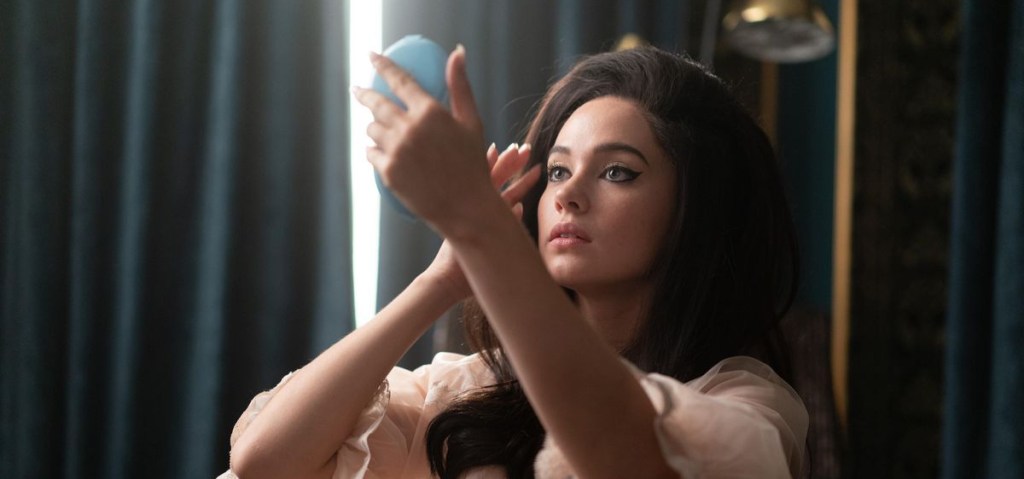
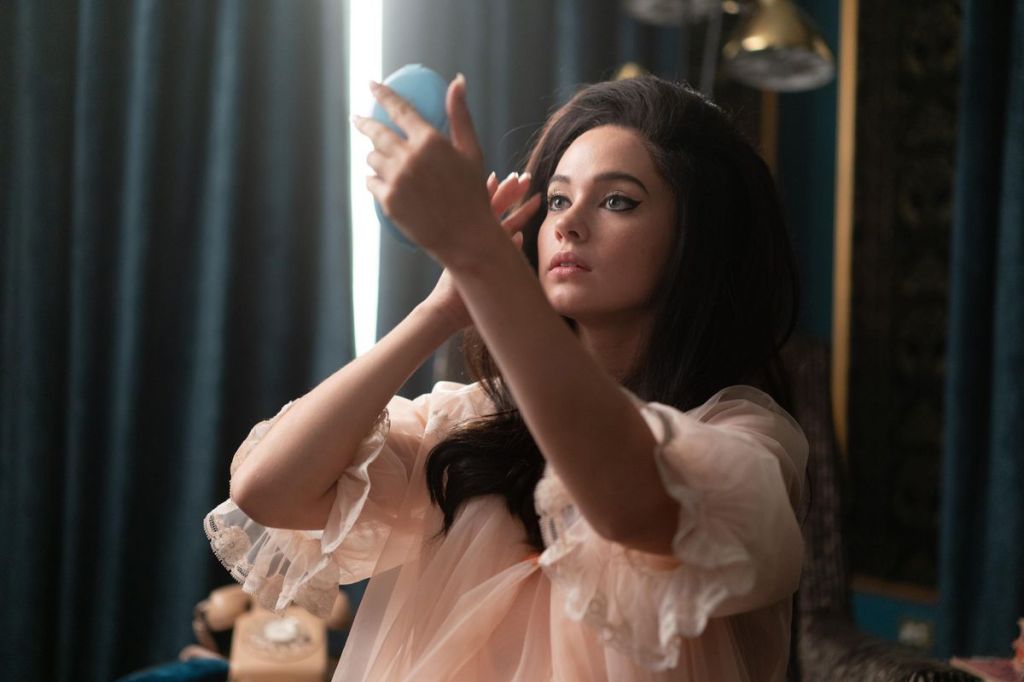
The story of Priscilla Presley is a fascinating one – so much gossip and heartache that was aired out for the entire world to see, resulting in the public feeling like they were part of Priscilla and Elvis’ relationship. But do we really know the story of Priscilla Presley? It feels like it’s one that is always behind the shadow of that of Elvis himself – never a story told strictly from her perspective, from her own words. Maybe it’s due to our fascination and obsession with pop culture icons such as Elvis, and the idea of revealing what might be behind the curtain is off-putting to so many people. However, when it comes to Priscilla, director Sofia Coppola makes Priscilla the focal point of her own story and agency.
Based on the memoir Elvis and Me from Priscilla Presley herself, Priscilla chronicles the relationship of Prisicilla and Elvis Presley – from the moment they met when she was just 14 to the end of their marriage. Where Baz Luhrmann’s Elvis broadly told the story of everything that occurred within Elvis’ life, Sofia Coppola sticks closely to Priscilla’s own words from her memoir; she lingers in the quiet spaces of the giant mansion she lived in, often alone when Elvis was on tour. Coppola is also not afraid to tackle the more unsettling moments between the two and the clear dysfunction at the center of it.
One of the most fascinating aspects about Sofia Coppola as a filmmaker is her eye for both aesthetics and how she blends that with very raw, aching emotion. With Priscilla, she quite brilliantly creates a fantastical and dream-like setting that makes you feel as if you’re in Priscilla’s shoes; swooning and aching over a first-love who just so happens to be the biggest musical icon in the world at the moment. Yet as the film progresses, it begins to tear down the facade brick by brick until it fully reveals the bitter and dysfunctional core. The film never lingers too long when it comes to dwelling in the dysfunction, but it feels boldly ready to take on the parts of Elvis’ life that other depictions don’t want to tackle.
Casting Priscilla feels like such a daunting task, for both Priscilla and Elvis Presley alike. In regards to Priscilla herself, unless you cast multiple actresses, you have to have someone who can embody both a teeanger as well as a 24-year-old woman. Cailee Spaney is a performer who has turned in some really impressive work in the past, but nothing quite prepared me for how brilliant she is here. She is the heart and core of the entire film, and gives such a nuanced, reserved, and devastating performance; balancing both the innocence and maturity of Priscilla greatly.
Jacob Eloridi, who gives a regularly fantastic performance on HBO’s Euphoria, also turns in impressive work here. The power of a performer such as Jacob is that he doesn’t traditionally look like Elvis Presley, but when he plays Elvis.. you believe it regardless. His mannerisms are so on-point but he manages to showcase both the swagger of Elvis that people were drawn to, as well as exhibiting how fragile and unhealthy he was in many different areas of his life. A lot of performers and filmmakers would exhibit Elvis’ more problematic elements with a large emphasis, but both Eloridi and Coppola seem to be more interested in showing how quietly manipulative and abusive he was; making for the larger, scarier moments behind closed doors all the more effective. It simply feels more real when it’s done with this much subtlety.
Eloridi and Spaney together craft a really remarkable chemistry that is as magnetic as it is heartbreaking to watch. Coppola also turns in some of her best directorial work in quite some time – I’d go as far as to say this is her best film since 2003’s Lost in Translation. Both of these components compliment each other beautifully, as Coppola crafts a dream-like romance that feels completely fantastical; riding off of Eloridi and Spaney’s chemistry. But Coppola’s keen eye for emotion and sadness is apparent in almost every scene as well, and she uses those very strong sensibilities to show how truly tragic this relationship was. All around, it feels like such an impressive piece of work that says so much while being so reserved.
4/5
 Films for Breakfast
Leave a comment