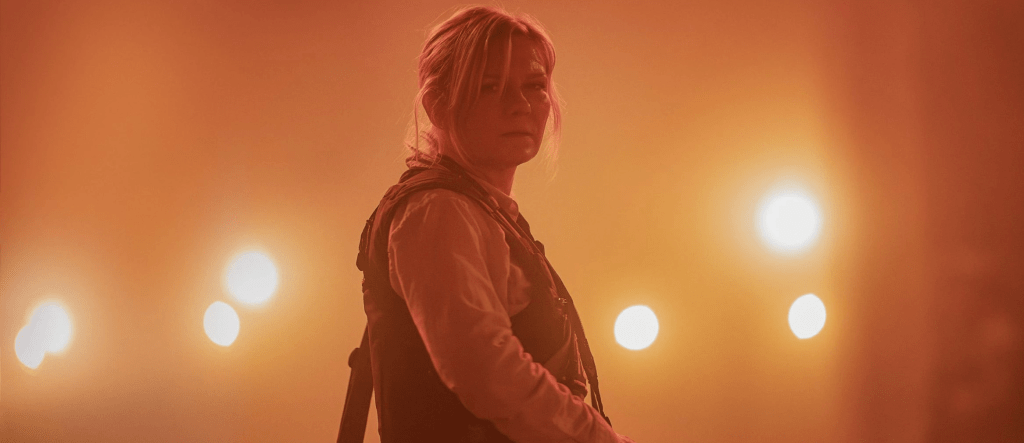

Alex Garland is a perplexing filmmaker in the sense that he never delivers quite what you’re expecting him to – and that’s a good thing. His last film, Men, completely caught me off guard due to how cerebral and abstract it was compared to Annihilation, Ex Machina, or even his FX show Devs, which all feel so rich in detail, scope and meaning. In his latest film, Civil War, Garland depicts an America in the not-so-distant future (and you can decide, as a viewer, how far away it is from potentially happening) where the states of California, Texas, and assistance from Florida form the “Western Alliance” and rage a Civil War across the country as they aim to take down the president (Nick Offerman) unless he surrenders to their military forces.
If you were expecting the film to be from the perspective of soldiers or politicians you’d be sadly mistaken, as Garland opts to frame it from the frontlines of war-time journalists and photographers. The leads of the film are Lee (Kirsten Dunst) and her partner Joel (Wagner Moura) as they attempt to drive from New York to Washington, D.C. in the middle of an ongoing Civil War to interview the president. Along for the ride are seasoned journalist Sammy (Stephen McKinley Henderson) and rookie photographer Jessie (Cailee Spaeny), much to Lee’s discomfort. Through the lens of these characters, the film clearly has a fascination with the desensitization of democratic collapse and political violence taking place. There’s also a vastly interesting, reoccurring theme throughout about the power of journalism and documenting significant historical events from the frontline, regardless of the cost on your own sanity.
Garland is a filmmaker that clearly knows how to utilize tension and striking imagery within his films, and Civil War is absolutely no different. There are so many incredibly fascinating and grueling moments of hard-hitting imagery that is bound to stick with you. Specifically speaking, a stand-out moment in the film is an extended sequence featuring Jesse Plemons as a deranged soldier that will have you guessing what he could possibly do until the moment he leaves the frame. If you happen to be able to do so, I highly recommend checking out the film in IMAX as it adds a lot to the already incredible technical accomplishments, beautiful production design, and effective sound mixing/design. Purely in terms of scale and tension, the film is vastly impressive.
The film also paves way for some truly incredible performances. Kirsten Dunst does wonders with playing a completely jaded and traumatized journalist who can neither shake nor turn away from this line of work and the urge to tell a story. Cailee Spaney is equally fantastic in the film as the hotshot rookie who slowly understands the horror of war and collapse of democracy happening around her. Wagner Moura, Stephen McKinley Henderson, and even performers with less screen time like Jesse Plemons or Nick Offerman do an excellent job at making the film as harrowing as it is.
Unfortunately, on the flip side of all these positive notes I have about the film, I found it to be extremely messy. It’s not lost on me that the film is deliberately making a point to not directly mirror today’s politics and remain vague about the background of this Civil War for thematic purposes; but, to me, it feels like it lessens the impact of everything depicted in the film when there is no real perspective being given. I would argue that if you’re going to make a film that is riding the coattails of the clear, real-world unrest we’re currently facing in America with your film, I’d expect you to have more a political or even ideological stance on the matter. Even if it is completely fictional and not a direct representation of our current politics, at least have the audacity to take some kind of stand of perspective if you’re going to depict a modern day American civil war.
By the end of the film, where there are large set pieces set within Washington, D.C., it feels more like the third act of an action film than a depressing insight into the final days of a democracy and nation before it potentially falls. There are moments of effective imagery as you watch (former?) Americans attempt to take the life of the president and fight with historic monuments in the background; but imagine how much more effective it would be if the film bothered to have more than one moment of exposition explaining, extremely vaguely, how this all went sideways and what this current administration/government is doing to make it worse. One quick line about the dismantling of the FBI and term limits are a nice start, but it shouldn’t be all there is.
On the one hand, Civil War is undeniably an incredibly intense and often times hard to watch film about the collapse of a democracy and nation. There are interesting themes at play regarding our isolation to violence in our own nation, the heroism and maybe even selfishness of documenting all of this from the frontlines, and some truly impressive sequences that linger on discomfort and tension. However, it feels like Civil War sacrifices a genuine perspective for easier rushes of discomfort and adrenaline. There are undeniably some interesting themes to pick out from its angle, but it fails to realize how instrumental it is to convey actual stances and nuances if you’re going to make a film depicting an American civil war. By the end, the more undercooked elements of Civil War unfortunately outshine the positives that are undeniably there. An ultimately toothless experience that isn’t without some great moments and performances but feels like it could’ve been so much more at nearly every turn.
2.5/5

 Films for Breakfast
Leave a comment