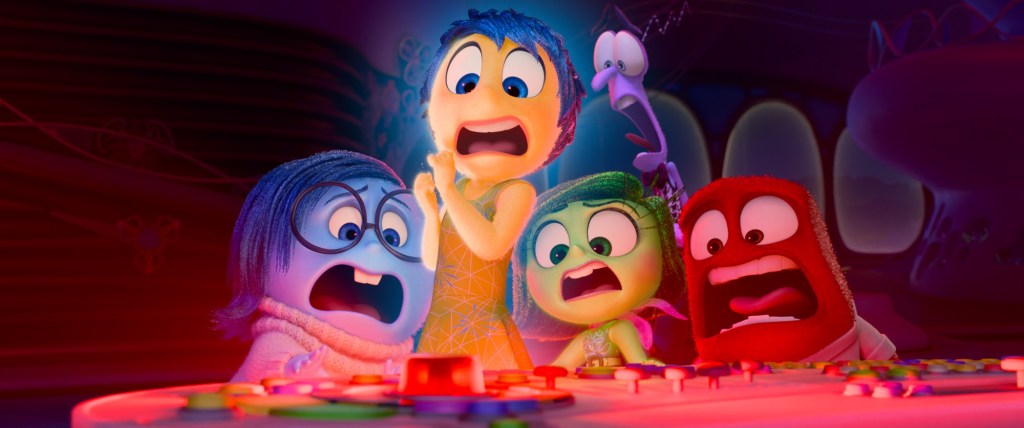

The original Inside Out broke grounds and touched countless lives due to its immense originality and unique visualization of our emotions, articulated and presented in a way that children could easily understand and identify with. Having worked with kids in the past, I can attest to how powerful the original film is and how many kids found the characters to be genuinely useful as tools to help themselves navigate their own emotions. If that isn’t a testament to the power of cinema – what is? Inside Out 2 takes place a few years after the events of the first film, with Riley (Kensington Tallman) now dealing with all the typical issues that teenagers do – and her emotions of Joy (Amy Poehler), Sadness (Phyllis Smith), Fear (Tony Hale), Anger (Lewis Black), and Disgust (Liza Lapira) are all trying their best to keep-up with her day-to-day life experiences. However, when Anxiety (Maya Hawke) and a whole other slew of new emotions like Envy (Ayo Edbiri), Ennui (Adele Exarchopoulos), Embarassment (Paul Walter Hauser), and Nostalgia (June Squibb) come crashing into Riley’s head one day, Joy and all the other established emotions try to make sense of all of Riley’s unexpected new experiences and feelings at her arsenal.
One of my favorite aspects to both Inside Out films is how they center around a seemingly small-scale event in Riley’s life; in the first film, we find her in the middle of moving away from her hometown and getting adjusted to life in a big city. With Inside Out 2, we find Riley at hockey camp for the summer alongside her closest friends as she tries to prove her self-worth to the cool, older new girls she hangs out with, the coach of her hockey team, and most importantly… herself. A lot of the emotional turmoil of the film harkens to the root of anxiety and the nature of how debilitating and earth-shattering it can feel for a teenager experiencing it for the first time. A lot of the interactions and hurdles Riley comes across in the film aren’t groundbreaking in the grand scheme of things, but director Kelsey Mann (with a screenplay also written by Mann, Dave Holstein, and Meg LeFauve) finds a perfect balance within taking a small life event and evoking much emotion out of it; making for something incredibly authentic and truthful about how anxiety makes everything feel so much heavier than it actually is.
It almost goes without saying at this point, but Pixar has truly knocked it out of the park with their animation this time around. Much like the first film, I’m absolutely astounded by the detail and craftsmanship found in every frame this film has to offer. In the outside world, all of Riley’s experiences and interactions are so perfectly visualized and I’m really blown away by how much care is put into the simplest of details like the posters in her bedroom, how detailed the ice is anytime she plays hockey, strands of hair and facial features, etc. But inside of Riley’s mind is where the film really impresses with its animation, as it somehow adds even more layers to its visualization of our emotions and adds natural extensions of Riley’s personality and feelings that feel completely accurate to how they would’ve evolved at this point in her life. One of the most thought-provoking and moving is the visualization of her core values and self-image, and how there’s a direct correlation between those things and her memories and anxiety. This is really powerful, effective stuff that I think will help a lot of people, not just kids, feel seen.
The plot mechanics here feel a bit looser this time around, compared to the first film which I believe has one of Pixar’s tightest screenplays. However, where it may falter in narrative tightness it makes up for in sheer entertainment, genuine laughs, and big ideas. As far as the comedy goes, the film is as equally funny as the original, with the cast all delivering some truly great work. Amy Poehler continues to shine as Joy this time around, in a role where her entire perspective is once again challenged in a unique way. Phyllis Smith’s Sadness and Lewis Black’s Anger gets some truly stand-out moments here as well, as it feels like they continue to be two of Pixar’s most inspired casting choices – and Tony Hale and Liza Lapira effortlessly step into the roles of Fear and Disgust. As for the new cast, I thought not only did the actors do a fantastic job at joining in the ensemble (Maya Hawke and Ayo Edebiri are standouts) but held their own as the central themes of the film, namely that of Anxiety, which really is the heart of the film and one that I think so many will find universally relatable.
There are moments where Inside Out 2 feels like it may be a bit more small-scale than the original and it certainly doesn’t have as many tear-jerking moments (how can you beat Bing Bong?), but on the flip side, there is simply a lot of restraint, nuance, and maturity within the screenplay that I think elevate this as an extremely worthy sequel. Much like Riley at this point in her life, the film has more complex emotions and not everything feels as black and white as it once did; sometimes seemingly simple obstacles feel like the end of the world to us for reasons we can’t explain, but the film beautifully examines the messiness and confusion that comes along with anxiety, as well as the beauty and clarity that occurs when you learn you can overcome and restrain it. Inside Out 2 is an immensely hopeful, emotional rollercoaster that got more than a few tears out of me, and an abundance of laughs as well; truly the kind of magic only Pixar can deliver.
4.5/5

 Films for Breakfast
Leave a comment