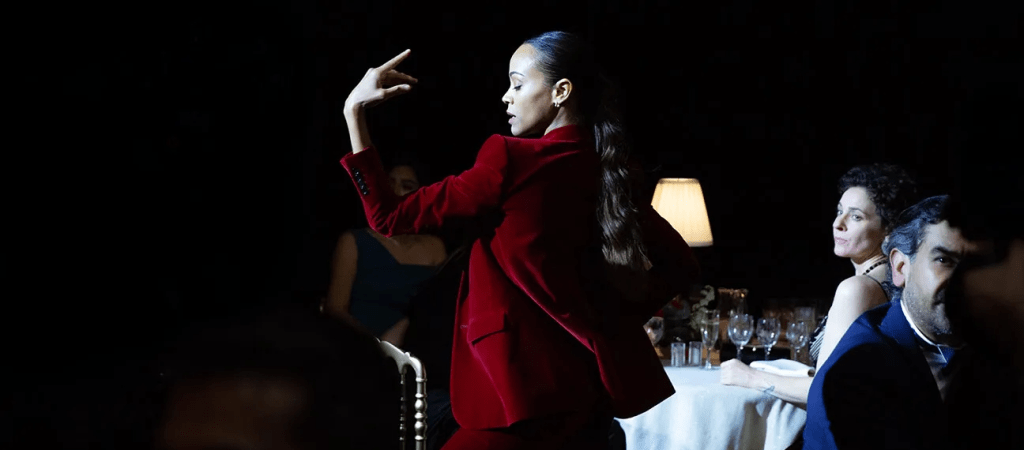

How does one even review Emilia Perez? Let alone explain what Emilia Perez is about? Sure, I could tell you that it’s about an unappreciated yet viciously talented lawyer named Rita (Zoe Saldana) who is hired by the leader of a criminal organization for a peculiar task she doesn’t expect – but that doesn’t quite cover that experience that Emilia Perez is while you’re watching it. On top of being a film about a criminal organization, it also serves as a story about the trans experience, operates as a thriller, a familial drama… oh, and did I mention it’s also a musical? If all of these things seem like they may not mix coherently, you’d be right!
Director Jacques Audiard is quite a fascinating filmmaker, who has made films that I really admire – A Prophet is a favorite of many, but Rust and Bone has particularly stuck with me throughout the years. He clearly likes to mix it up within genre with each new project he tackles, as each film is so radically different than the one he made before. So in that sense, it feels inevitable that a film like Emilia Perez exists; that feels like a sprawling epic of clashing tones. The film has been met with mostly rave reviews, although it has its detractors.. and I hate to say that I fall into the category of the latter, although there are some elements to it that I quite admire.
To first focus on the positives, I think the performances are quite excellent across the board here. Karla Sofía Gascón turns in a remarkable and deeply vulnerable performance as the titular character Emilia – I have never seen her perform in other films, but this is quite an audacious effort from her that truly pays off. Selena Gomez, who plays Emilia’s estranged wife Jessi, also turns in a career-best performance here – she often feels like the heart of the film, but never goes overboard with emotion. Their chemistry together is really what holds the film together. However, for my money, Zoe Saldana gives the best performance in the film as Rita – simply because it’s so radically different than anything I’ve seen from her before. She carries the entire film and has the most to do both dramatically and musically, delivering on both in spades. Truly a fantastic performance.
Even when the film starts to falter for me, I have to continually hand it to Jacques Audiard, as Emilia Perez is never anything less than fascinating. If I don’t like a film, I’d prefer for it to at least be something like Emilia Perez where I feel like I still have something to take away from it and admire about it despite my issues with it. For about 70% of the films runtime, I think Audiard does a fantastic job at directing the film and the cinematography from DP Paul Guilhaume really works overtime in keeping up with the sprawling tonal and stylish choices it feels like Audiard is striving for.
However, the other 30% of the film is really what hinders it for me and feels more damning than the half that works. The musical elements are likely what you’ll hear the most about when you read or listen into conversations about Emilia Perez; the issue for me is that save for one sequence right around the middle of the film, the musical sequences are largely forgettable and uninspired within presentation. While I think the most recent Joker film from Todd Philips did a worse job at incorporating musical elements into an unlikely story, Emilia Perez often suffers the same fate as having musical numbers that feel like a hindrance to the narrative rather than a natural component of the films’ DNA.
While the performances largely worked for me across the board, I found the actual dramatic material they were given to be more shallow than I expected. Maybe you can blame the fact that the film is spinning too many plates at once to truly nail any one key component, but I simply didn’t find any of the character arcs or motivations to be entirely interesting. For example, Zoe Saldana’s Rita starts in an interesting position as a lawyer who feels both proud of her skills yet weighed down by the fact that she is helping clearly guilty criminals with no remorse for their actions – even ones who will likely hurt others again. This is a fascinating element that the film builds up at the start, but for my money, never really follows through with in an interesting way.
I believe this notion rings true for all the characters in the film, specifically Emilia herself. I’m not here to speak on behalf of the trans experience, only how the character was presented to me as a viewer. The film feels like it is trying to set up an interesting route for redemption and a question of how easy it should be for her as someone who has contributed to many terrible things in her country, but largely the film feels like it doesn’t explore these ideas as in-depth as they should and by the end feels like it largely cuts these explorations short. This feels incredibly frustrating as the film cuts to credits, as you’re left with conflicting emotions – yet not in a way that feels deliberate, but from a screenplay that is spinning too many plates to deliver anything meaningful.
A lot of these complaints are even more frustrating when you compare them to the elements of the films that do work – like Rita’s opening moments in trials and setting up for cases, or more tender moments between Emilia and her estranged children. There are plenty of moments here that work brilliantly, but the whole picture feels largely confused and like it is tackling too much for its own good. An admirable effort, but mostly a miss in my eyes.
2/5



 Films for Breakfast
Leave a comment