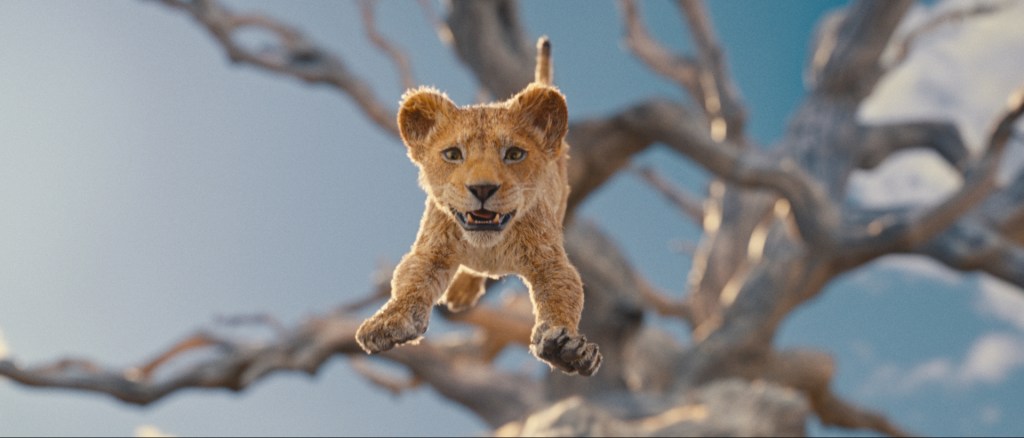

Disney’s The Lion King remake (which I hesitate to call live-action) from 2019 was received mixed if I’m being generous – it feels like the type of film that everyone forgot within a week of release, yet it somehow made a staggering $1.6 billion worldwide and currently sits as the tenth highest grossing film of all-time. While I don’t hate the remake like some do, I did find it incredibly forgettable and I was pretty content with avoiding any follow-up to the film that Disney produced, as their remake department has been really missing the mark here lately. However, that attitude changed when Barry Jenkins, director of the Academy Award winning film Moonlight, signed on to direct Mufasa; a staggering choice that immediately peaked my interest and confused me in equal measure.
Mufasa: The Lion King is told in flashbacks through the narrator of Rafiki (John Kani) to the daughter of Simba (Donald Glover) and Nala (Beyonce), Kiara (Blue Ivy Carter) – with some intersections from Timon (Billy Eichner) and Pumbaa (Seth Rogen). The film largely follows a young Mufasa (Aaron Pierre) as he journeys with his adopted brother Taka (also known as Scar, played by Kelvin Harrison Jr.), Sarabi (Tiffany Boone), Zazu (Preston Nyman), and a young Rafiki (Kagiso Lediga). The pair find themselves on a journey to find a home for their respective families and find their destiny in the circle of life, while forming the core relationships we see displayed in the original films.
Prequels are always inherently tricky, as it’s hard to overcome the sense of feeling unnecessary. However, the best prequels like X-Men: First Class or the most recent Planet of the Apes films, focus largely on telling a compelling story in its own right rather than neatly and satisfyingly connecting the dots or providing easter eggs for future films. With Barry Jenkins behind the camera, I was hoping that Mufasa: The Lion King would fall into the categories of both one of the better live-action Disney adaptations of late, as well as a compelling prequel in its own right. Unfortunately, it largely falls into the same trappings that I feel prequels are largely associated with and fails to tell a story that justifies to exist.
On paper, I can see why Barry Jenkins would be attracted to this idea on paper. There’s a compelling story at its core about Mufasa and Scar becoming brothers, and learning about the world and their different views as they get older. I also, in theory, like the story of Mufasa learning how to become a good leader rather through his kindness and experiences with other animals – it didn’t happen over night. My issue with the film largely stems from the fact that the screenplay feels at odds with itself, as one side feels focused on these larger and deeper themes, while the other side feels hellbent on keeping it a lighthearted movie musical for kids. While I’m aware that it’s a Disney film and these elements are expected, a lot of the best Disney films do find a balance between these two tones – Mufasa never quite does.
The film also suffers from the same issue that the original 2019 remake does as well, which is that I find the general aesthetic and photo-realistic animals to be incredibly off-putting. While there is seemingly more of an effort this time around to make the animals more expressive and emotive with their facial features, it really isn’t enough. I largely feel nothing when seeing these animals move their mouths in the most monotone ways. This photo-realistic aesthetic makes the film feel incredibly drab and bland in comparison to the original animated film – none of the musical numbers pop, and none of the shots of landscapes wowed me. It all feels so artificial and dull.
A criticism that I’m a bit surprised that I have is that of the music. Lin Manuel-Miranda was hired to do almost all of the original songs this time around, and since you’re not remaking the original film again, I thought this was an excellent idea. While I don’t think these songs are necessarily bad (saved for one song sang by the villain, you’ll know it when you see it) – they surprisingly lack much vibrance in their rhythm, catchiness in their lyricism, or dramatic punch/thematic meaning to the larger story – at least any that I found moving or effective. This is surprising because it’s something that Lin is usually quite good at when it comes to music in the films he’s part of, and I think it genuinely really hurts Mufasa.
The story ranges from boring to fine, never really going above or below either threshold. As I previously stated, the film is at its best when it is trying to explore the relationship dynamic between Scar and Mufasa – Aaron Pierre and Kelvin Harrison Jr. are turning in impressive vocal performances here that make these scenes standout. But the film feels like it is also beholden to its lackluster musical numbers and action set pieces, all of which pack no punch with the dry visuals on display. The humor is also pretty lackluster, as I found Timon and Pumbaa’s inclusion in the story to be more distracting and grating than anything.
If I sound like a scrooge on this one, I promise it brings me no pleasure to dislike the latest Barry Jenkins’ film – he’s a filmmaker I’ve been wildly excited about ever since I first saw Moonlight in 2016. There are moments in the film where you can feel his humanistic touch, whether its in the aforementioned character beats between Mufasa and Scar, or some experimental bits with the camera in certain action sequences. However, it feels like the film is largely too beholden to formula that it can never quite break the mold and become a compelling story in its own right. This unfortunately is a reminder of what prequels should aspire not to be.
2/5
 Films for Breakfast
Leave a comment