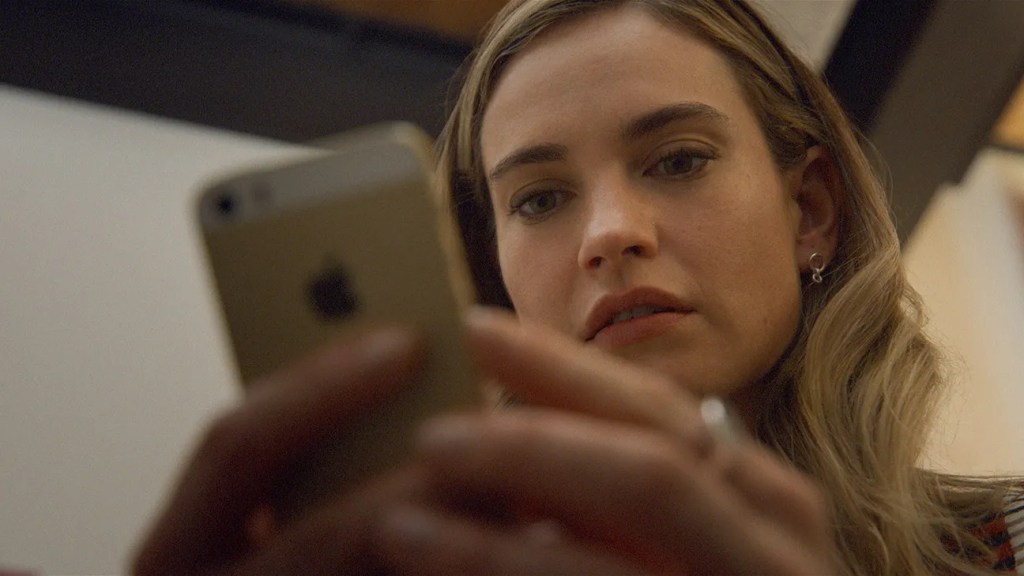
Given how deeply dating apps have embedded themselves into modern culture – and how frequently Hollywood churns out biopics about companies and their creators – it’s almost surprising that it took this long for a film to tackle the origins of one of the biggest apps on the scene for the last decade. Swiped follows the story of Whitney Wolfe (Lily James), who went from working at Cardify to co-founding Tinder before ultimately launching Bumble. On paper, that trajectory is compelling enough that it feels like a film about it should practically make itself… right?
Swiped is an interesting watch, though maybe not in the way its filmmakers intended. For a story with such inherently fascinating subject matter, the film feels oddly sanitized. It presents interesting events and ideas, like Whitney Wolfe navigating workplace harassment while building an app designed to empower women, or the tension between being a business leader and remaining an ally to other women. At what point does power compromise identity and mission? Does success inevitably blur conviction? These are the kinds of questions the film gestures toward but never truly explores, leaving the final product frustratingly surface-level. Watching it, I couldn’t help but imagine the sharper, more probing version of this story that might have been.
The film’s first act feels especially rushed and overly cutesy. You could argue that this bubbly tone is intentional; a reflection of Whitney’s early optimism, while the darker shift later mirrors her hardened outlook after navigating a male-dominated industry. That reading isn’t lost on me. The issue, though, is that the tones never fully cohere, and the opening half is weighed down by awkward writing, breezy editing, and stilted performances. As a result, the admittedly stronger second half struggles to recover. By the time the film finally became genuinely engaging, I realized it was in its last ten minutes.
Lily James is a talented actress who’s delivered strong performances in films I’ve greatly enjoyed, but I never really bought into her portrayal of Whitney Wolfe here. Her performance feels overly theatrical, bordering on cartoonish, to the point where she comes across less like a person and more like a vessel for the screenplay. Like the film itself, she finds more humanity in the latter half, but even then, it feels unearned – more like an actor adjusting to shallow material than a natural evolution of character.
Rachel Lee Goldenberg’s direction is brisk and stylish enough to keep things moving, especially given how much ground the film tries to cover – not just Whitney’s career, but also the rise of Tinder and Bumble. While I wished for more dynamic filmmaking, Goldenberg isn’t the problem. The real issue lies with the screenplay, which feels fundamentally inept. Learning it was written by three different people wasn’t a surprise; the film never settles into a consistent tone or vision.
There are flashes of something more interesting, particularly toward the end, when Whitney is forced to balance her role as a public figure with the compromises of taking on a new business partner. The film briefly flirts with the morally gray territory of her professionalism versus her principles; but by then, it feels like too little, too late. If the most compelling ideas arrive in the final stretch, that’s not a good sign.
By the end, Swiped feels like a major missed opportunity. Instead of digging into the thornier questions at the heart of Whitney’s story, it plays more like a Wikipedia adaptation, content with skimming the surface rather than finding an actual angle for its story. These are the kinds of biopics I find least compelling and that most should use as a blueprint for what to avoid when tackling a story. By the time the credits rolled, I wasn’t just underwhelmed, I was wishing for another filmmaker to take a crack at this story with more daring, depth, and perspective.



 Films for Breakfast
Leave a comment