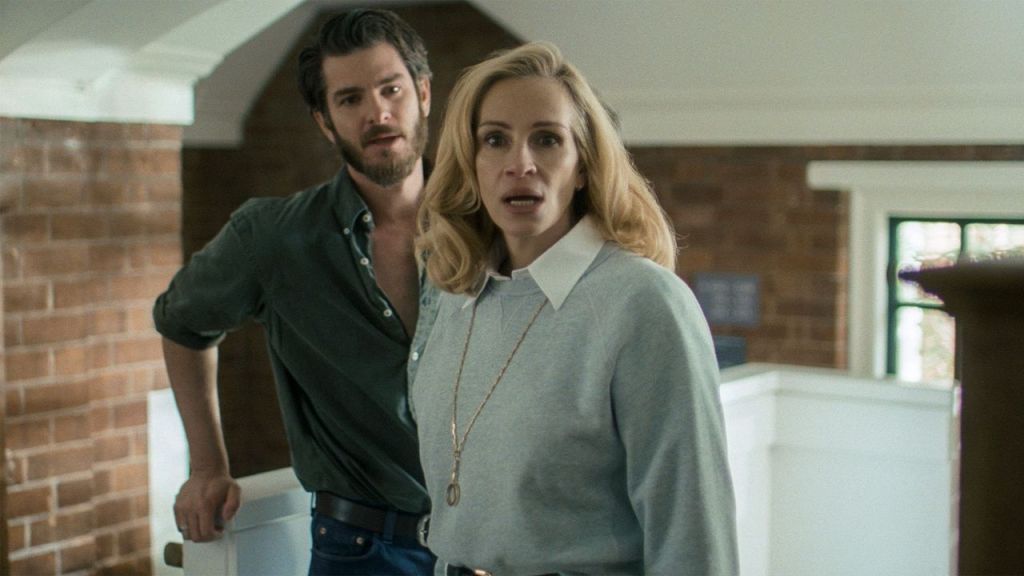
Luca Guadagnino is a filmmaker who thrives on exploring complex characters and thorny moral territory. With his latest film, After the Hunt, it feels as though he’s reached the peak of that fascination – telling a story about some of the most intricate and morally ambiguous people he’s ever brought to the screen. The film follows Alma (Julia Roberts), a respected college professor whose seemingly stable life begins to fracture when her star student, Maggie (Ayo Edebiri), levels serious accusations against one of Alma’s colleagues, Hank (Andrew Garfield). As the situation spirals, Alma finds one of her own long-buried secrets threatening to resurface amid the growing chaos.
From the opening moments, there’s a sense that every shot and technical choice has been considered down to the bone – yet the film itself carries an undercurrent of unpredictability. Guadagnino’s direction is unshowy but exacting; he allows scenes to breathe and conversations to spiral naturally, often letting characters talk themselves into corners. He lingers on private exchanges; the kinds of things said behind closed doors that would never be uttered in public. It’s here that After the Hunt finds its most fascinating rhythm: in its quiet deconstruction of the cyclical blame we assign to older or younger generations, all while sidestepping the harder act of self-reflection.
Performance-wise, the cast is uniformly excellent. Julia Roberts is particularly remarkable – she retains the sharp wit and effortless charisma that made her an A-List star, but layers it with vulnerability and a quiet current of fear and exhaustion that runs beneath every exchange she finds herself in. Ayo Edebiri, Andrew Garfield, and Michael Stuhlbarg all deliver standout work in the supporting ensemble, each bringing a different shade of tension and humanity to the film’s moral maze. Garfield, in particular, is riveting – his performance shifts between charm, resentment, and raw desperation with unnerving precision. It’s one of his most unpredictable and deeply felt turns in years.
On a technical front, After the Hunt is largely impressive. Malik Hassan Sayeed’s cinematography is dynamic and consistently engaging, while Marco Costa’s naturalistic editing choices give the film a unique rhythm – some days seem to stretch on endlessly for these characters, while others slip by with disorienting speed. That manipulation of time subtly mirrors the emotional states of the people we’re watching. And of course, it wouldn’t be a Guadagnino film without an exceptional score from Trent Reznor and Atticus Ross. While this is one of their more subdued works in recent memory, the undercurrent of dread and melancholy they bring to the film is deeply effective, adding a quiet pulse of unease beneath every scene.
Where the film falters, unfortunately, is in its screenplay. It’s frustrating in the sense that half of it feels brilliant; razor-sharp in its ideas and character work, while the other half leans too heavily into self-conscious provocation, as if too eager to confront the audience head-on. There are moments of beautifully vague ambiguity that invite interpretation and discussion, but also stretches, particularly in the third act, where the narrative feels cornered and characters make bafflingly unrealistic decisions. It’s surprising that only one screenwriter is credited, as the film occasionally has the uneven texture of something written by committee.
What we’re left with is a film that’s narratively messy and more complicated than most viewers will have patience for. For every electric sequence brimming with sharp dialogue and great performances, there’s an emotional distance – a cold undercurrent that occasionally keeps the audience at arm’s length. Some of the film’s threads feel deliberately unresolved, but the whole thing is so steeped in moral grayness and human contradiction that it’s hard not to admire how boldly it embraces that mess. Guadagnino seems to revel in the chaos; in watching people contradict themselves, in revealing how fragile certain convictions really are.
By the end, After the Hunt is deliberately frustrating – but whether that frustration feels worthwhile will depend entirely on your subjective read of it. For me, the film asks enough difficult questions, crafts enough fascinating characters and situations, and delivers such tremendous performances that I can’t help but admire it, even with its flaws. It’s not one of the year’s best films, but it’s certainly one of its most thought-provoking – a film I haven’t stopped thinking about since I first saw it.

 Films for Breakfast
Leave a comment