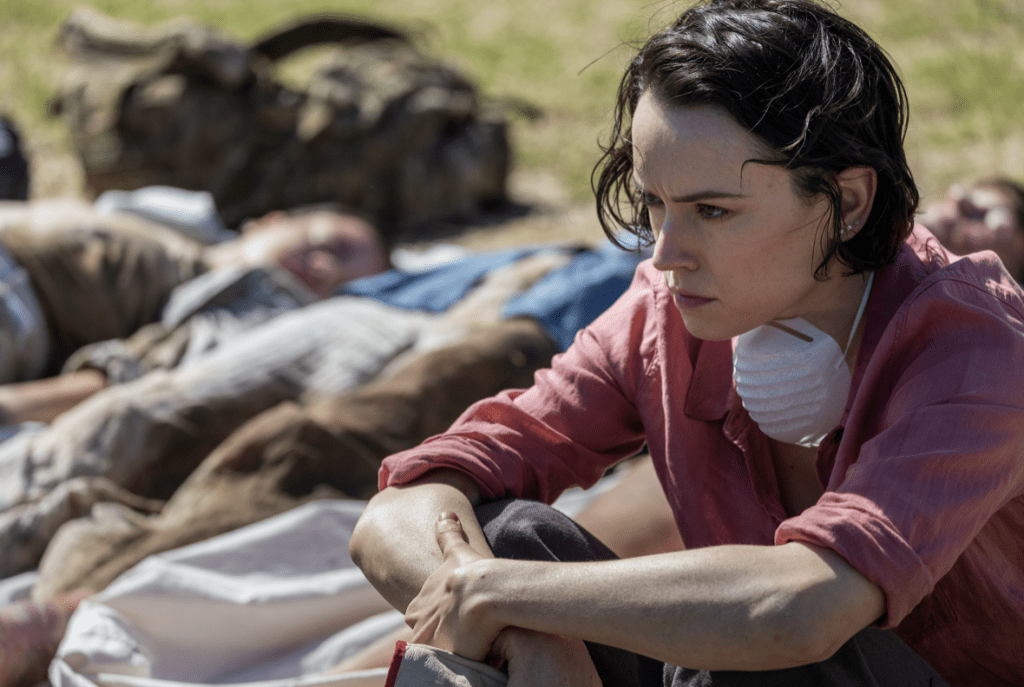
As the horror genre continues to expand, it has become increasingly difficult to inject it with genuine life and originality. Nowhere is that challenge more apparent than in the zombie subgenre, where audiences often just want the basics: brains, blood, and gnarly deaths. But ever so often, a film comes along that meaningfully bends the rules. Danny Boyle’s 28 Days Later (and later 28 Years Later) did this. George A. Romero’s Night of the Living Dead did this. And I’m happy to say that We Bury the Dead finds a fascinating and sincerely original angle on the well-worn formula. It’s been a long time coming.
The film follows Ava Newman (Daisy Ridley), a desperate woman searching for her husband in the aftermath of a catastrophic military experiment. Clinging to the hope that he may still be alive, Ava joins a body retrieval unit tasked with burying the dead – only for her mission to take a chilling turn when the corpses she’s interring begin to show unsettling signs of life that lead her to rethinking the entire operation, and the undead as she knows them.
It goes without saying that Daisy Ridley is a star; she became one the moment she stepped into the lead role of the largest franchise in the world with Star Wars: The Force Awakens. In the years since The Rise of Skywalker, however, she has smartly devoted herself to smaller, more intimate projects that better showcase her range as an actor. I was already impressed by her work in 2024’s Sometimes I Think About Dying, but We Bury the Dead may be her most compelling performance yet. Without giving too much away, Ridley plays a character who is emotionally conflicted on multiple levels — deeply human, deeply flawed, and morally grey. She finds a quiet, aching humanity in Ava that adds an unexpected layer of heart to the film and sustains nearly the entire experience.
I was equally impressed by the direction from Zak Hilditch, who also wrote the screenplay. His approach to framing the undead is steeped in sadness and melancholy, a striking departure from the way zombies are typically portrayed in the genre. And yet, when the film pivots toward tension, it is utterly unrelenting. We Bury the Dead manages to have its cake and eat it too, presenting the zombie apocalypse as a profoundly tragic event that shakes humanity to its core, without ever allowing that sadness to dull the very real danger of the situation.
Conceptually, the film is especially fascinating. Only a portion of those who die as a result of the military experiment return, and the common thread is that each of them has unfinished business with someone, or something, still living. This empathetic framework fundamentally reshapes our relationship to the dead, lending the film an almost ghost-story quality rather than that of a traditional zombie thriller. It’s a risky tonal shift, but one that works remarkably well, often in ways that genuinely surprised me.
The only element that truly holds the film back is that it cuts itself a bit short rather than fully diving into its themes. At a brisk 95 minutes, the film is admirably lean and focused, but it feels as though there was room to explore more scenarios within this world – opportunities that could have deepened its thematic impact and expanded its scope within the genre.
Still, We Bury the Dead stands as a thoughtful, emotionally resonant reimagining of zombie cinema, anchored by a career-best performance from Daisy Ridley and a confident, empathetic vision from Zak Hilditch. It may not exhaust all of its ideas, but the ones it does explore linger long after the credits roll; a reminder that even in the most overcrowded subgenres, there are still new ways to talk about grief, humanity, and the things we refuse to leave behind.
 Films for Breakfast
Leave a comment