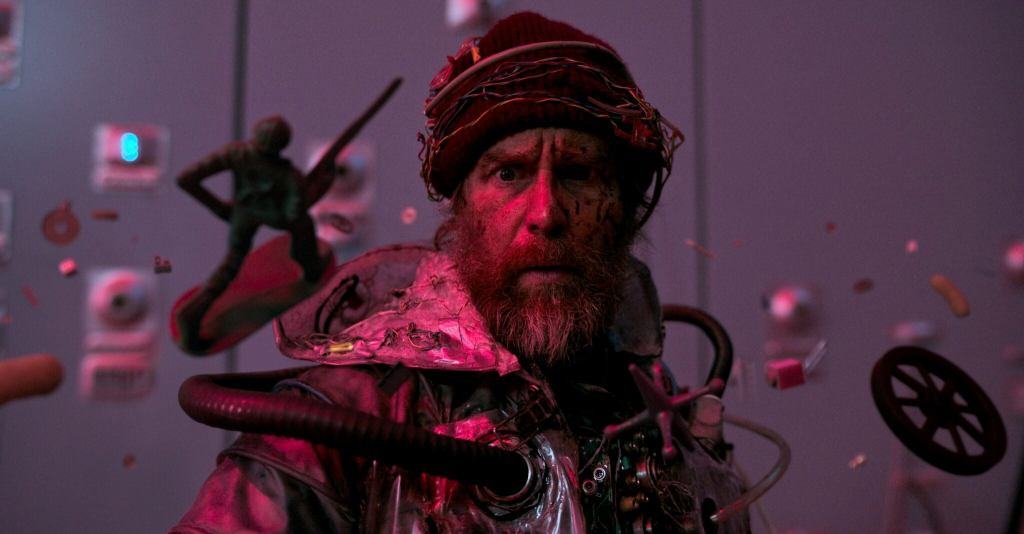
Looking back at the history of cinema, particularly from the 1980s onward, it’s clear we’ve never lacked films warning us about the dangers of artificial intelligence, or at least of advanced technology spiraling beyond human control. With Good Luck, Have Fun, Don’t Die, Gore Verbinski offers a scathing indictment not only of AI itself, but of what happens when we willingly sell off our emotions, memories, and lived experiences to corporate monopolies and opaque algorithms.
The film opens with an immediate jolt: a mysterious man claiming to be from the future storms into a Los Angeles diner. His mission? To recruit a handful of unsuspecting patrons to help him stop a rogue AI that, in his timeline, has already destroyed the world. By traveling back to this exact night, he insists, catastrophe can still be prevented.
This opening stretch is genuinely terrific. Sam Rockwell enters guns blazing, delivering rapid-fire monologues and endlessly amusing one-liners with a screen presence that remains virtually unmatched. I didn’t clock the runtime of this sequence, but for as long as the film allows Rockwell to command the diner; circling patrons, selling the gravity of his mission, and chewing through dialogue – I was completely locked in. Every moment of it rules.
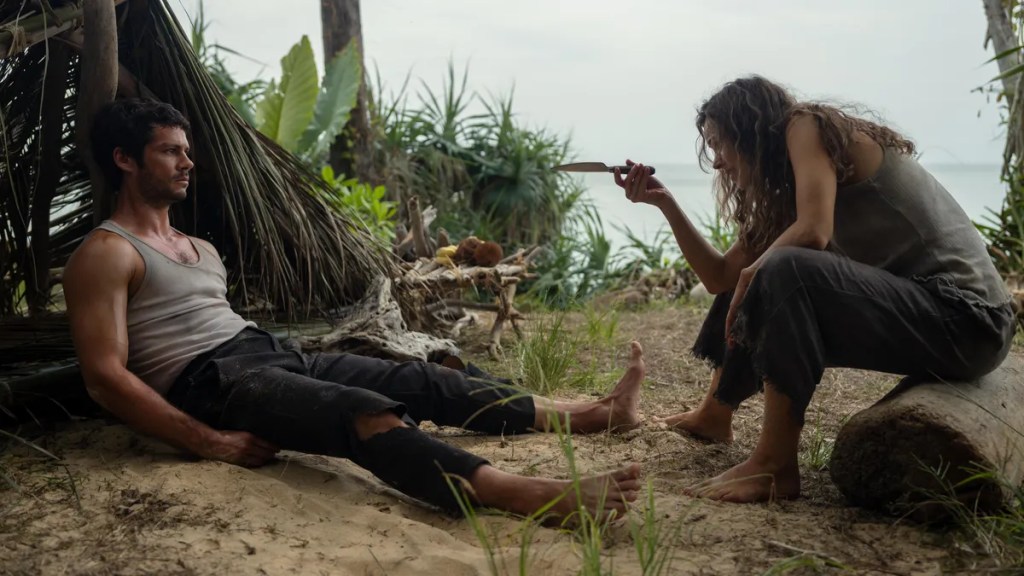
While the film doesn’t fall apart after this opening, it also never quite reaches the same high again. As the narrative expands, the story fractures across timelines, filling in the backstories of the Mysterious Man’s recruits: Ingrid (Haley Lu Richardson), whose fraught relationship with technology defines her arc; Janet (Zazie Beetz) and Mark (Michael Peña), grappling with AI-driven algorithms warping the minds of younger generations; and the standout thread following Susan (Juno Temple), who, after a devastating loss, turns to cloning a loved one complete with artificial memories as a means of coping.
Structurally, Good Luck, Have Fun, Don’t Die functions like an oversized season of Black Mirror, built around a single overarching narrative and several flashback-driven mini-stories, each exploring a different technological anxiety. What truly distinguishes it, however, is Verbinski’s unmistakable hand. His balls-to-the-wall approach results in an electric tone, relentless pacing, and an infectious sense of momentum that makes the film consistently entertaining, even when it stumbles thematically.
One of the film’s most impressive achievements is how effectively it leverages its modest budget. While no official figure has been confirmed, it’s been reported that the film cost under $10 million – a staggering fact given its frequent reliance on visual effects, elaborate set pieces, and large crowds of extras. Despite those limitations, the film looks confident, stylized, and far more expensive than it has any right to. It’s one of the most impressive examples of low-budget ambition I’ve seen in quite some time.
That said, the screenplay isn’t without its issues. At times, the film’s anti-AI and anti-technology messaging veers into “old man yelling at cloud” territory, expressing broad disdain without fully articulating a deeper or more nuanced perspective. While the fear of technology eroding our jobs, identities, and autonomy is undeniably universal, the film often stops short of pushing those ideas into more challenging or revelatory territory – particularly once it reaches its narrative endpoint.
Even so, I found Good Luck, Have Fun, Don’t Die to be an immensely entertaining ride. Gore Verbinski remains one of our most singular mainstream filmmakers, and it’s reassuring to see him still operating at peak weirdness. If nothing else, the film is worth seeking out for Sam Rockwell’s phenomenal lead performance alone – he’s an absolute force here, and deserving of every ounce of praise he gets.
 Films for Breakfast
Leave a comment