Pixar has been in an interesting position lately. On one hand, they’ve never truly entered a lull period. Even over the past 10–15 years, they’ve consistently delivered good-to-great films – from Inside Out, Soul, and Toy Story 3 and 4 are all fantastic in my book. On the other hand, they’ve become increasingly sequel-driven, and their output doesn’t quite hit the staggering batting average of their late ’90s and early 2000s heyday, when masterpiece followed masterpiece. Today, it feels like they reliably produce solid, occasionally great films. That’s hardly a bad track record – but part of me can’t help wishing they’d fully recapture that earlier magic.
Enter Hoppers, a film that almost feels like an antidote to both sides of that equation. In an era where sequels dominate Pixar’s slate, Hoppers is wildly original and hilarious. The story follows Mabel Tanaka (Piper Curda), an ambitious environmentalist determined to protect a local animal habitat – a mission complicated by Mayor Jerry (Jon Hamm), who plans to bulldoze the land to build a highway. Mabel discovers a group of college scientists who have developed technology that allows humans to “hop” into lifelike robotic animals. Using the tech, she inhabits a robotic beaver, immerses herself in the animal community she’s fighting for, and works to sabotage the mayor’s plans from the inside.
Compared to many mainstream family films today, Hoppers feels refreshingly inventive. Conceptually and narratively, it’s deeply weird; and not just because of the central premise. Without spoiling anything about where the story goes, once Mabel integrates into the animal world, the story veers into some of the most delightfully odd territory I’ve seen in a family film in years. That weirdness is precisely where the film thrives. Mabel is an inherent outsider, someone who feels more at home with nature than with most people in her life – a dynamic established right from the start.
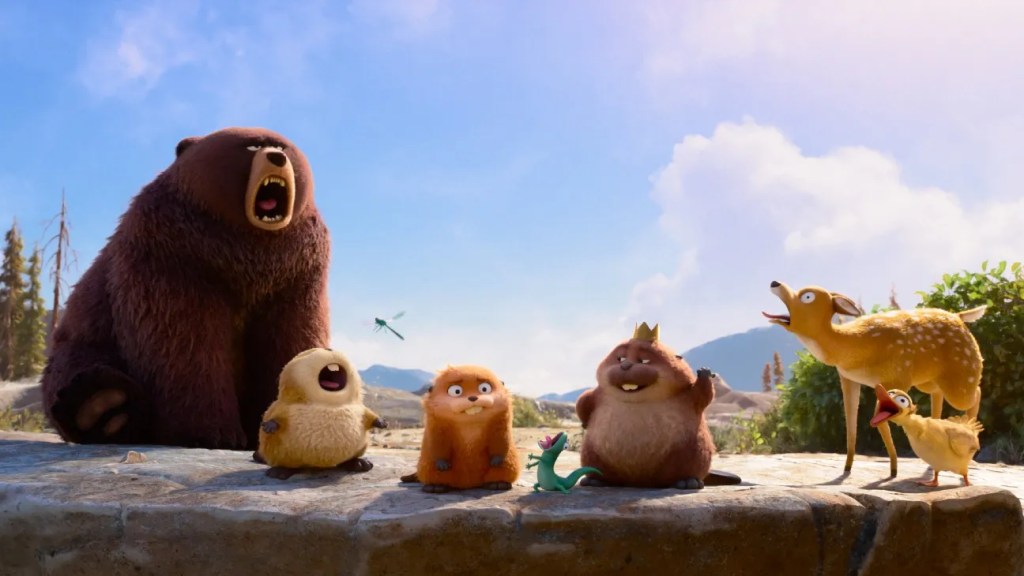
Stylistically, the film mirrors her offbeat sensibilities. The animation feels scrappier and more experimental than Pixar’s typically polished aesthetic. It’s somewhat reminiscent of Turning Red in its embrace of stylization over realism, but Hoppers goes even further, fully abandoning realism in favor of a bold, distinctive visual identity. The animation is still technically impressive; it simply prioritizes personality over photorealism.
The ensemble of characters is endlessly lovable and a huge part of what makes the film so entertaining. Among the eccentric animal personalities Mabel encounters, King George (Bobby Moynihan), a fellow beaver and the leader of the mammals – and he absolutely steals the show. Moynihan’s performance is effortlessly funny and deeply endearing, perfectly capturing George’s naïve idealism and warm-hearted spirit. It’s a classic Pixar scenario: the side character runs away with the movie.
The broader voice cast is equally strong. Piper Curda and Jon Hamm anchor the film confidently, but the supporting comedians voicing the habitat’s animals – from Vanessa Bayer, Melissa Villaseñor, Dave Franco, Meryl Streep, and Eduardo Franco; each bring distinct comedic rhythms to their roles. Too often, celebrity voice casting can feel like a marketing ploy. Here, everyone genuinely commits, and it shows. The line deliveries consistently land.
Interestingly, Hoppers occupies a slightly different emotional register than many Pixar films. It isn’t structured as a traditional tearjerker. If I have one critique, it’s that I wish the film devoted more time to Mabel’s personal life outside the habitat. While we’re given a strong introduction to her worldview, a more sustained throughline with her family might have added additional dramatic weight. I can imagine some viewers finding the film immensely fun but a touch emotionally distant – even if I don’t fully share that sentiment.
Still, there’s a clear trade-off. While Hoppers may not carry the same emotional heft as Pixar’s most devastating classics, it bursts with originality. The story constantly reinvents itself, pivoting in unexpected directions just when it seems to settle. That sense of audacity, of a studio taking genuine creative swings, is invigorating.
Ultimately, Hoppers feels like a major win for Pixar. It pushes them into genuinely uncharted territory, standing apart not only from their own filmography but from the broader landscape of contemporary family movies. It has a sweet heart at its core, but it’s the film’s wild ambition, eccentric humor, and unapologetic weirdness that make it such a triumph.
 Films for Breakfast
Leave a comment