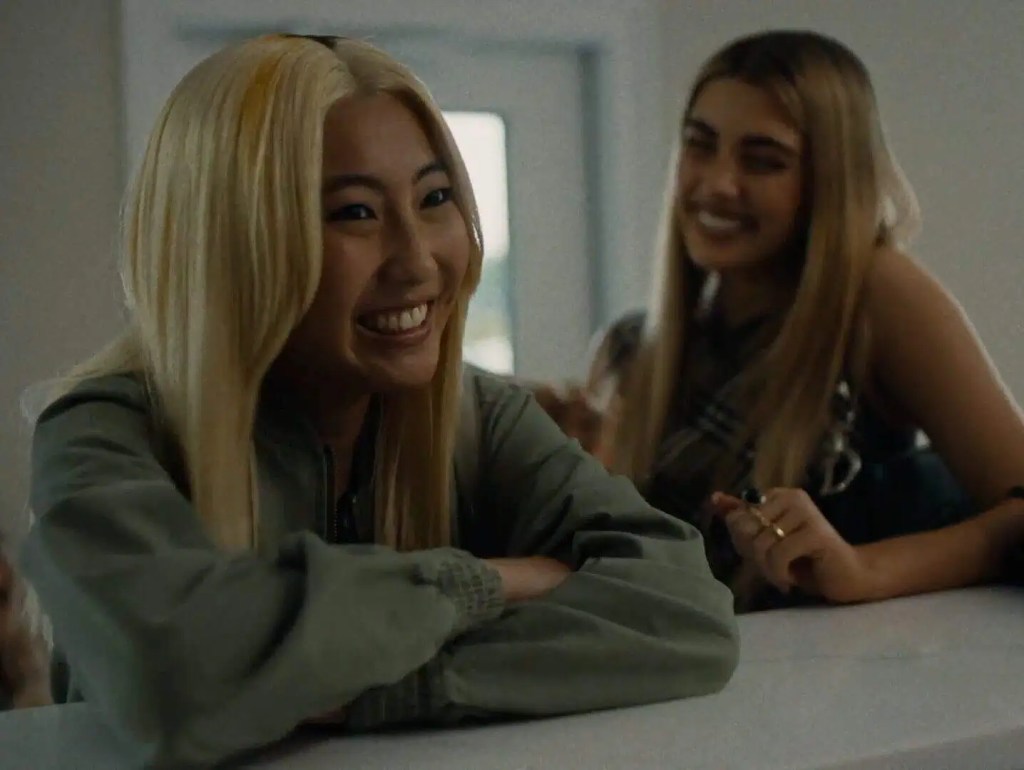
How does one even begin to review Slanted? In case you aren’t familiar, the film follows Joan (Shirley Chen), an insecure Chinese-American teenager who feels like she doesn’t belong anywhere at school. After discovering a shady company promising a radical procedure that could change her life, Joan undergoes surgery to become white – hoping it will finally earn her the acceptance she craves and perhaps even land her the title of prom queen.
Inherently, Slanted is a tricky film to talk about – and for that, I applaud it. Amy Wang crafts a satire that is bound to make some viewers uncomfortable. It blends elements of body horror (albeit fairly tame), coming-of-age drama, and racial satire. That’s not an easy tonal tightrope to walk, but Wang’s vision remains compelling from start to finish.
The performances are largely strong. Shirley Chen, who plays Joan for the first half of the film, does a terrific job conveying the anxiety and loneliness that drive her decision; so much so that you can almost understand her spur-of-the-moment choice, ridiculous as it may seem. McKenna Grace takes over the role after the surgery, which is arguably the more difficult task, yet she handles it impressively well. It genuinely feels like a seamless baton pass between performers, with Grace carrying over Joan’s same sadness and insecurity while leaning into an awkward fish-out-of-water dynamic that works nicely.
The film is at its best when it leans into the awkward social rituals Joan tries to navigate post-surgery in order to finally fit in with her peers. These moments are framed as both hilarious and deeply sad – almost pathetic in a way that really clicked for me. At the same time, the film strikes a thoughtful balance by showing what Joan loses in distancing herself from her culture. Her parents, played by Fang Du and Vivian Wu, remain proud of their heritage, and their performances help ground the film emotionally.
From a satire standpoint, the film lands more often than it misses. Not every joke hits, but it aims high and maintains a solid batting average throughout. The body horror elements are also fairly restrained and only appear when they serve the story, so anyone hesitant about the film for that reason shouldn’t worry – it’s a very small component overall.
My main issue is that, despite its clever observations, Slanted never really surprised me. For satire especially, I think a certain level of unpredictability is essential. Once the central premise kicks into gear, the narrative becomes fairly easy to anticipate at nearly every turn. It remains entertaining and amusing throughout, but I often felt like I could see each beat coming from a mile away.
By the end, though, Slanted still stands out as something unique. It feels like a deeply personal and singularly observed piece of work that is consistently engaging and often funny. While I wish it pushed its concept into stranger, more daring territory, it ultimately still worked quite well for me.

 Films for Breakfast
Leave a comment