It can often feel like we are in a drought of true spectacle, blockbuster filmmaking that isn’t purely a sequel or superhero film. I won’t pretend that Project Hail Mary is purely original, as it is indeed based off a very popular book – but the grand spectacle on display, the fact that it is anchored by a truly fantastic performance from an A-List star, and is entirely held together by genuine emotion and pure, old-fashion craftsmanship and movie-magic is what makes this truly standout in the crowd in the already packed year of 2026.
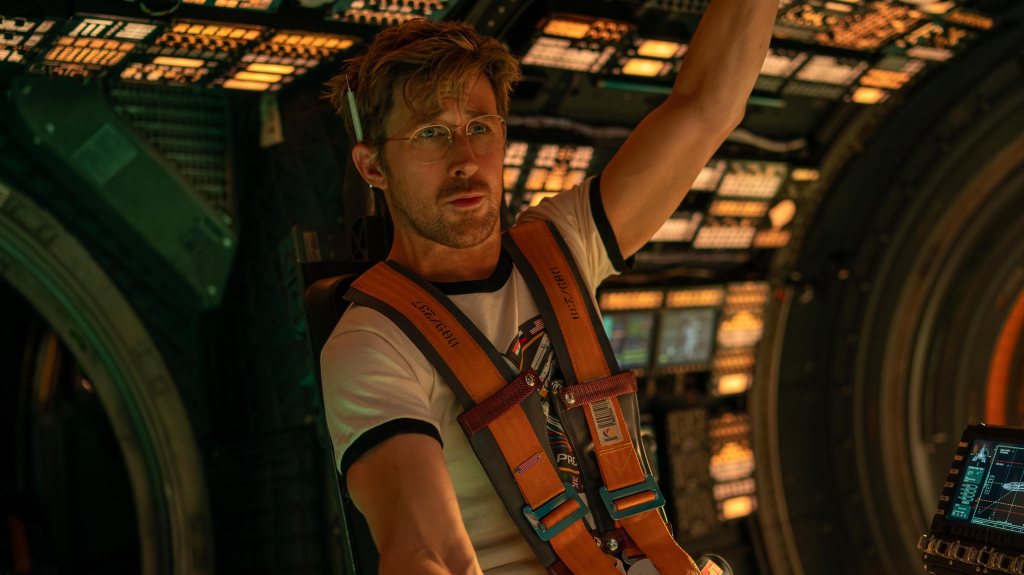
The film follows Science teacher Ryland Grace (Ryan Gosling) who wakes up on a spaceship with no recollection of who he is or how he got there. As his memory slowly returns, he soon discovers he must solve the mystery behind a floating substance that’s causing the sun to die out. As details of the mission unravel through his mind, he is left with his pure wit and skill to get the job done. However, he comes across an unexpected guest for his mission that changes everything for him.
Full transparency: I loved Andy Weir’s novel, so I went in already assuming to like, at the very least, simply like this adaptation. But even with that in mind, what Phil Lord and Chris Miller accomplish here genuinely exceeded my expectations. They take the spirit of the book and translate it into something cinematic in a way that feels both faithful and creatively energized, maintaining the story’s humor and humanity while fully embracing the visual possibilities of the medium – especially if you are lucky enough to see it in IMAX.
Lord and Miller have always been pretty remarkable filmmakers; especially in the comedic realm. But something that I have always loved about their work, specifically from The Lego Movie and the Jump Street films, is how much heart is quietly laced underneath the absurdity. On a pure filmmaking standpoint, Project Hail Mary might be their most impressive balancing act yet. The film shifts seamlessly between comedy, suspense, and awe-inspiring set pieces without ever losing its footing. The humor feels organic to the characters and the stakes of the situation they find themselves in. It’s the kind of storytelling that trusts the audience to engage with both the spectacle and the emotion at the same time, and the result is a film that feels both thrilling and deeply sincere.
Visually, the film is stunning. Greg Fraser’s cinematography gives the entire movie a sense of scale and texture that elevates the material tremendously. Fraser has already proven himself one of the great modern cinematographers through work like Dune and The Batman, and here he once again demonstrates a remarkable ability to capture both grandeur and intimacy; genuinely – both the space sequences and shots inside the cabin of the ship are equally breathtaking here. He knows how much of the film will take place inside close-quarters, so Fraser takes full advantage of that and crafts a gorgeous visual style for the Hail Mary.
On top of the sequences inside the ship – when it does venture outside into deep space, it is absolutely stunning. The vastness of space is rendered with a sense of beauty yet isolation and brutality in several sequences. There are two or three moments, that I won’t spoil, that are simply jaw dropping – what the film merely accomplishes with pure color-popping visuals left me more starstruck (no pun intended) than any elaborate action set piece I have seen recently.
The visual effects work is equally extraordinary, particularly when it comes to the creation of Rocky – Rylan’s unexpected passenger and quickly-turned best friend. Translating that character from page to screen was always going to be a massive challenge; especially when you know how Rocky is described in the novel. There is an inherent language barrier between the two of them that is easier to execute on page, but the film pulls it off with astonishing confidence. Rocky feels completely real within the world of the film – expressive, curious, and emotionally legible despite being something so fundamentally different to Rylan. They don’t just make him a simply likable sidekick, but a fully fledged supporting character with his own arc and emotional core. It is a staggering achievement of visual effects.
Ryan Gosling anchors the entire film beautifully as the leadign man. His performance is full of the kind of effortless movie-star charm that makes him such a compelling screen presence, but he also brings a vulnerability that grounds the character in a very human way. Much of the film relies on his ability to carry scenes alone, reacting to discoveries, setbacks, and moments of wonder, and he makes every beat feel engaging. Gosling has always had a sharp comedic instinct, and that plays wonderfully here, particularly as Ryland begins to try and cope with the impossibility of his situation. But there is some pure emotional distress and self-doubt in the character that I think Gosling really dug into beautifully here, making for one of his best performances in years.
At the heart of the film, though, is the relationship between Ryland and Rocky, which becomes the story’s emotional center. What begins as a fascinating scientific mission gradually evolves into something simultaneously deeper and, appropriately, smaller. Their relationship is built upon mutual respect for one another, trust in science, and Rylan’s ability to seemingly only open up about his fears to Rocky. The film spends the time necessary to develop that relationship, letting it grow naturally through small discoveries and moments of mutual understanding. The two are an excellent comedic pairing, as well – a true buddy comedy with a huge heart at its core.
The film is also supported by a fantastic score from Daniel Pemberton and soundtrack that enhance both the wonder and the tension of the story. The music knows when to swell into something grand and when to pull back to allow quieter emotional beats to breathe. It complements Fraser’s visuals beautifully, helping create a sense of scale that makes the entire adventure feel appropriately epic while still keeping the focus on the characters. I was also really impressed by the supporting cast, but found Sandra Huller’s performance in particular to be a standout.
What ultimately makes Project Hail Mary work so well is how confidently it embraces both sides of its identity. It’s a massive science-fiction spectacle filled with breathtaking visuals and high-stakes problem-solving, but it’s also a story about curiosity, cooperation, and friendship. Lord and Miller manage to deliver something that feels thrilling, funny, thoughtful, and emotionally resonant all at once. It’s the kind of film that reminds you how powerful blockbuster filmmaking can be when it’s driven by strong characters, bold ideas, and genuine sincerity. It is the full package.


 Films for Breakfast
Leave a comment