It’s definitely the year of Stephen King, with 2025 delivering a flood of adaptations. We’ve already had The Life of Chuck, The Long Walk, and The Monkey release. And now, the latest is The Running Man. What’s great is that even though the quality has varied with these adaptations, the distinct directorial voices behind them have made each project feel wholly unique. This should have been especially true for The Running Man, where the biggest draw for the new adaptation is director Edgar Wright behind the camera. Though his last film, Last Night in Soho, was a quieter outing, the idea of Wright helming a traditional action movie was exciting. After all, his work on Baby Driver and Scott Pilgrim serve as an excellent reminder of his capabilities in the genre.
The film centers on Ben Richards (Glen Powell), a working-class man desperate to lift his family out of poverty and sickness. He is convinced by ruthless network executive Dan Killian (Josh Brolin) to enter a deadly reality show/competition: The Running Man. Ben is immediately thrown on the run, hunted by mercenaries and civilians drawn by a surging bounty that increases daily. The stakes are simple: survive the challenge, outsmart the hunters, and save his family for good.
Where the film ultimately falters is in its surprisingly conventional feel; it simply doesn’t register as an Edgar Wright film. While I appreciate a filmmaker stretching their muscles, much of The Running Man feels like standard studio action fare. To its credit, the action itself is solid (though featuring nothing as immediately notable as the chases of Baby Driver, perhaps) but it’s evident that Wright prioritized using as many practical locations, sets, and vehicles as possible. This commitment to practical filmmaking makes a genuine difference and elevates the sequences, an allowance I doubt other directors would have received.
However, many of the idiosyncrasies of Wright’s trademark style feel lost in the mix. One of his most defining traits is his meticulous attention to detail and his top-tier editing choices, which amplify every sequence to maximize its dramatic or comedic importance. Here, that visual flair is largely absent. There are no signature smash cuts, no hyper-stylized sequences; the film feels visually muted and lacking in excitement at times. It’s hard to tell if this represents a deliberate, self-imposed tonal shift from Wright or if the studio exerted control over his initial vision.
Is this stylistic restraint enough to sink the film? Not quite! The film remains decently entertaining for the majority of its runtime. One element that does work is the never-ending chaos inherent to the competition’s design. The premise, of a days-long reality show where the prize money and stakes progressively escalate with every mercenary and obstacle, inherently lends itself well to a compelling action narrative that organically builds stakes and keeps its pace going.
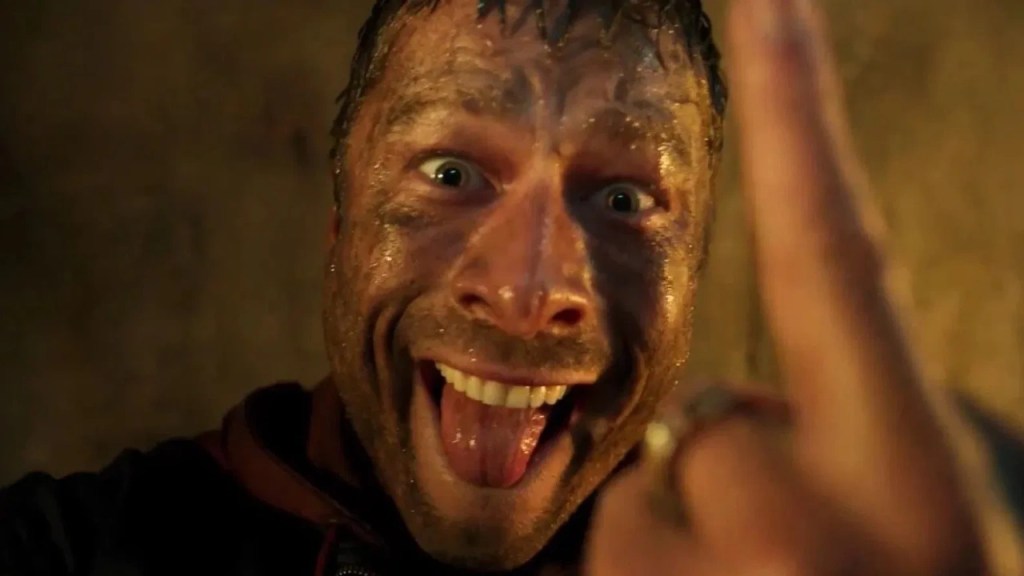
The film’s other undeniable strength is Glen Powell, whose meteoric rise to stardom has been well-deserved. I’ve admired his knack for honing in on a classic movie-star quality and picking projects that feel delightfully old-fashioned. His role as Ben Richards is a traditional archetype: the everyday family man putting his life on the line. Powell genuinely nails the comedic timing, the physicality of the action, and the character’s endearing nature, making him a top-notch lead who sustains the film’s energy.
The supporting cast is also largely impressive. Josh Brolin does a solid job as the main antagonist, a smug, shady producer who controls the competition from a looming corporate tower. I also found the always-excellent Colman Domingo to be a much-needed jolt of excitement in each of his scenes, while Lee Pace provides a great physical adversary for Powell, leading to some memorable third-act confrontations. I also can’t forget to shoutout Michael Cera as he provides the funniest segment in the film. A small but highly memorable role.
The element I remain most torn on is the film’s political commentary, which is a staple of King’s work. While there are brief, blunt moments that feel somewhat radical, and I appreciate the anti-authoritarian message at its core, the film ultimately pulls its punches. It constantly alludes to a powerful message that is never quite brought to the forefront, feeling less impactful and central than it was in the original novel.
Overall, this is a mixed effort for Wright. I appreciate his choices—the commitment to practical action, a charismatic leading man, and timely subject matter. However, the film constantly tries to build momentum yet never quite sustains that distinct, dynamic energy we expect. It flows as a serviceable and entertaining action film, but given that Edgar Wright is behind the camera, it’s not unfair to expect something more visually and tonally distinct.




Leave a comment