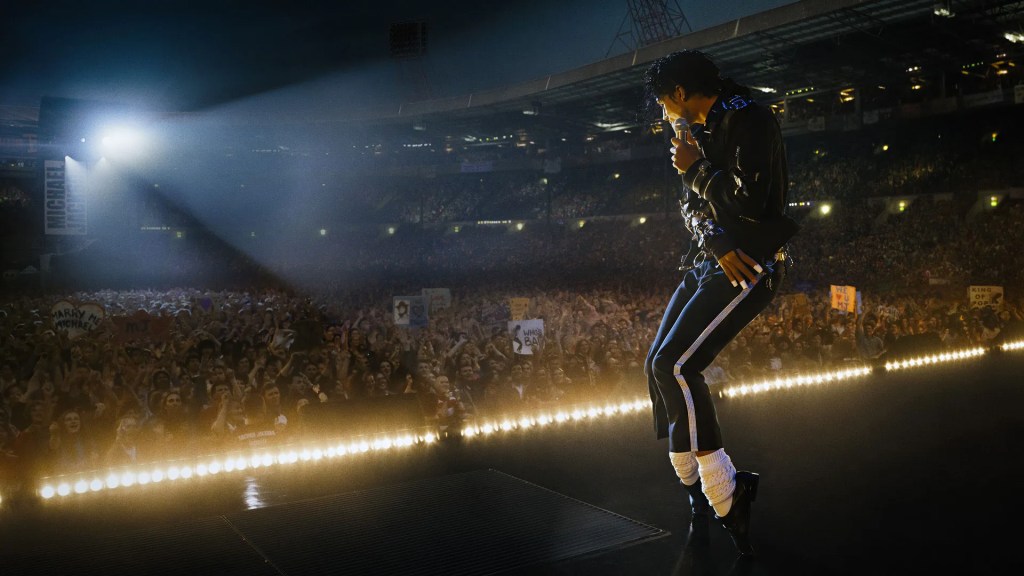
There isn’t a pop star, alive or dead, who’s immune to the biopic treatment. That’s not to say the genre is without its high points – hell, even recently, A Complete Unknown felt like a genuinely inspired take on Bob Dylan; one that carved out its own identity rather than checking off the usual boxes. But when it comes to someone like Michael Jackson, whose life spans through his time in the Jackson 5, a record-breaking solo career, and a long shadow of controversy – it’s hard to even conceptualize what a coherent, honest film would look like. And all of that’s before you factor in the involvement of an artist’s estate, which more often than not leads to something heavily sanitized. Just look at Bohemian Rhapsody.
Before Michael even entered production, his estate had been signaling for years that a film about his life was inevitable. From a cynical angle, it’s one of the most reliable ways to preserve (and monetize) an artist’s legacy after they’re gone. After a long road of rumors, reported reshoots, and creative overhauls, the film has finally arrived… and it’s more or less exactly what you’d expect from a multi-studio production shaped so heavily by an estate: sanitized and polished to a fault, and largely devoid of personality or much perspective aside from playing the hits with zero framing of what cultural relevance the man had outside of simply telling us that he had it.
And when I say “sanitized,” I don’t just mean its handling of Michael’s controversies (though that’s obviously a significant and worthwhile conversation, and one better explored elsewhere). I mean the way it renders Michael Jackson as a figure. Even if you fully believe his legacy is undeserving of scrutiny and that a biopic should celebrate him, it’s hard to argue this is the ideal version of that film. What you get instead is something that plays like a Wikipedia page brought to life – thin on insight into his creative process, vague about his inspirations (beyond surface-level nods to the movies he loved), and surprisingly inert on a visual level.
For an artist whose music videos redefined the medium, it’s baffling how little of that energy translates here. Thriller is arguably the most iconic music video ever made, and it is recreated with almost no sense of style or imagination this time around. They don’t even try to shoot it as interestingly as Michael himself did back in the day. Is this really the bar we are settling for?
Jaafar Jackson steps into the role of Michael Jackson, and the narrative unfolds exactly as you’d expect if you know anything about his life. We start in the ’60s with the Jackson 5, as Joe Jackson (Colman Domingo) pushes his children out of poverty and toward fame and fortune, and the film tracks Michael’s ascent through stardom all the way to the release of Bad in 1987. It’s a structure that conveniently sidesteps much of the more complicated material, favoring a procession of career highs over anything resembling a deeper excavation of the man himself.
I’ll give the film credit where it’s due, as I didn’t go in with a bad attitude. In fact, the opening 20–30 minutes, which focus on the formation of the Jackson 5 and Joe Jackson’s abuse (particularly toward Michael), are handled with a surprising amount of care. There’s a version of this movie that just stays there, zeroing in on that dynamic, and it might’ve been far more compelling. Colman Domingo’s is consistently strong, even under layers of distracting makeup; his performance cuts through regardless.
The film doesn’t linger there for long before shifting into Michael’s solo career, where Jaafar Jackson steps in – and to his credit, he really does impress. The mannerisms, the physicality, the choreography: it’s all there. He doesn’t always land the heavier dramatic beats, but considering this is his first film and the sheer weight of playing someone this iconic, it’s a genuinely solid and comitted debut.
Everyone else ranges from serviceable to forgettable. Miles Teller, in particular, drifts in and out as John Branca with what feels like near-zero investment. And the film offers little in the way of insight into Michael’s family beyond broad strokes. Nia Long’s Katherine is mostly reduced to delivering pep talks and standing up to Joe; she’s given almost nothing to do beyond that, which feels like a missed opportunity.
Antoine Fuqua is more than capable with the right material – Training Day is obviously fantastic, and even something like The Magnificent Seven or The Equalizer has a real sense of fun and grit. Which makes his work here all the more baffling. This is about as anonymous as his direction has ever felt. The sound design is predictably bombastic and, of course, the music does a lot of the heavy lifting – but the staging of the concert and studio-recording sequences have no spark whatsoever. There’s no sense of rhythm, no visual personality, no attempt to match the dynamism of the artist at its center.
It plays less like a film shaped by a director with a point of view and more like one assembled to satisfy a checklist handed down by producers and the estate. And that kind of creative constraint almost never results in anything that feels vital, let alone insightful or impactful. And it’s ultimately this sanitization that sinks the entire thing. The film settles into an almost comical rhythm: Michael performs an act of goodwill, creates another chart-topping hit, brushes up against some light familial conflict – then repeat, over and over, until the film decides. There’s no escalation, no deeper excavation, just a loop of greatest-hits storytelling.
It all culminates in a nearly 20-minute concert sequence that’s meant to feel like a grand finale, but lands with a thud. There’s no real sense of closure or insight – just a surface-level resolution with Michael briefly standing up to his father, as if that alone is enough to tie everything together.
The film ultimately plays like a by-the-numbers biopic, offering no real insight into Michael beyond what you could pull from a quick read online. There’s no meaningful perspective on his creative process, and, perhaps more damningly, it’s not even all that entertaining. I’ve loved Michael Jackson’s music for most of my life, even before I knew any of the controversies, but this just isn’t it – it feels less like a cinematic event and more like a glorified TV movie shot with IMAX cameras. By the end, the dramatic beats feel hollow, the concert sequences grow repetitive, and the story runs on autopilot. No matter where you land on the King of Pop, it’s hard to believe this is the most compelling version of his story we could have gotten.


Leave a Reply