Christopher Nolan has been one of the defining filmmakers of the 21st century – arguably the defining filmmaker of his generation. He has explored nearly every genre, developed an unmistakable cinematic style, and become one of the rare directors whose name alone can turn a film into a cultural event. His projects routinely attract A-list talent, with even the smallest supporting roles becoming coveted opportunities. All of that was true long before the juggernaut that was Oppenheimer, but after its historic box office success and awards sweep in 2023, it felt as though Nolan had ascended to an entirely different tier. Going forward, every new film of his carries the weight of a genuine cinematic event.
Between his work on The Dark Knight trilogy and his longstanding fascination with morally complex protagonists (characters defined by despair, failure, and the possibility of redemption) it feels almost inevitable that Christopher Nolan would eventually adapt The Odyssey. Homer’s epic is the quintessential story of a man seeking redemption for the consequences of his past while enduring seemingly insurmountable trials imposed by forces far greater than himself, all in pursuit of returning home. In many ways, it feels as though Nolan’s entire career has been building toward this film.
Nolan’s interpretation of the story is as fragmented and nonlinear as the original text itself. On one side of the narrative is Telemachus (Tom Holland), the son of King Odysseus (Matt Damon), who remains in Ithaca alongside his mother, Penelope (Anne Hathaway). With Odysseus presumed dead or imprisoned after more than a decade away, the palace has become overrun by dozens of boisterous, opportunistic suitors pining for Penelope’s hand in marriage, led most eagerly by the arrogant and overly zealous Antinous (Robert Pattinson). Alongside Mentor (Ryan Hurst) and the loyal swineherd Eumaeus (John Leguizamo), Telemachus is one of the few men left in Ithaca who still believes his father will return. Desperate for answers, he sets out on a journey to uncover the truth behind Odysseus’ fate.
Running parallel is Odysseus’ own story, which begins with the weary king recounting fragmented memories to Calypso (Charlize Theron) on her island. Disoriented and emotionally adrift, he struggles to remember how he arrived on her island, how long he has been stranded there, and, perhaps most painfully, what “home” even means anymore. Through these recollections, Nolan traces Odysseus’ harrowing voyage from the aftermath of the siege of Troy, following the infamous Trojan Horse deception, as he becomes increasingly convinced that the gods have cursed him for the devastation left in the wake of what was once believed to be a righteous campaign to reclaim Helen (Lupita Nyong’o) for Agamemnon (Benny Safdie).
As most would expect, Christopher Nolan takes the defining moments of The Odyssey and transforms them into a cinematic epic in the truest sense of the word. There are simply too many standout sequences to cover in a single review, but the highlights are staggering: encounters with the Cyclops and the towering Laestrygonians that are as devastating as they are exhilarating, nail-biting voyages across the open sea, an extended sequence on Circe’s (Samantha Morton) island that ranks among the most unnerving work of Nolan’s career, and, of course, a breathtaking realization of the siege of Troy. He stages these moments on such an overwhelming scale that it’s genuinely difficult to comprehend how they were accomplished. His vision for the film is so precise and unique to his voice; an easy shoe-in for yet another Best Director nomination at the Academy Awards next year.
What makes those sequences even more impressive is how thoroughly they’re grounded in practical filmmaking. The sheer amount of practical craftsmanship on display is astonishing – from the immense production design and stunning real-world locations, including extensive work on the open ocean, to the richly detailed costumes and meticulously choreographed battle sequences packed with hundreds of extras. Every frame radiates an ambition that feels increasingly rare in modern blockbuster filmmaking. This is an epic in every sense of the word.
The film’s technical achievements extend well beyond its spectacle. Nolan and editor Jennifer Lame weave Odysseus’ fractured memories into a dreamlike, nonlinear narrative that becomes increasingly rewarding as the story approaches its emotional climax. Hoyte van Hoytema’s cinematography is nothing short of monumental, repeatedly finding images whose scale and beauty left me speechless. Whether capturing the chaos of Troy, the majesty and terror of Odysseus’ voyages, or a haunting descent into Hades, van Hoytema consistently delivers some of the most awe-inspiring imagery of his career. Ludwig Göransson’s score is equally remarkable, providing another singular work that seamlessly shifts between overwhelming grandeur and aching intimacy while elevating every major emotional and action beat.
The performances are exceptional across the board. Even within an ensemble this stacked, nearly every actor leaves a lasting impression. If I had to single out a few standouts, Tom Holland, Anne Hathaway, Robert Pattinson, Elliot Page, Samantha Morton, and Himesh Patel consistently steal scenes, while Lupita Nyong’o and Jon Bernthal make the most of comparatively brief but memorable appearances. The real revelation for me, however, is John Leguizamo. His understated, deeply humane performance quietly becomes the emotional heart of the film, and I genuinely believe it ranks among the very best work of his career.
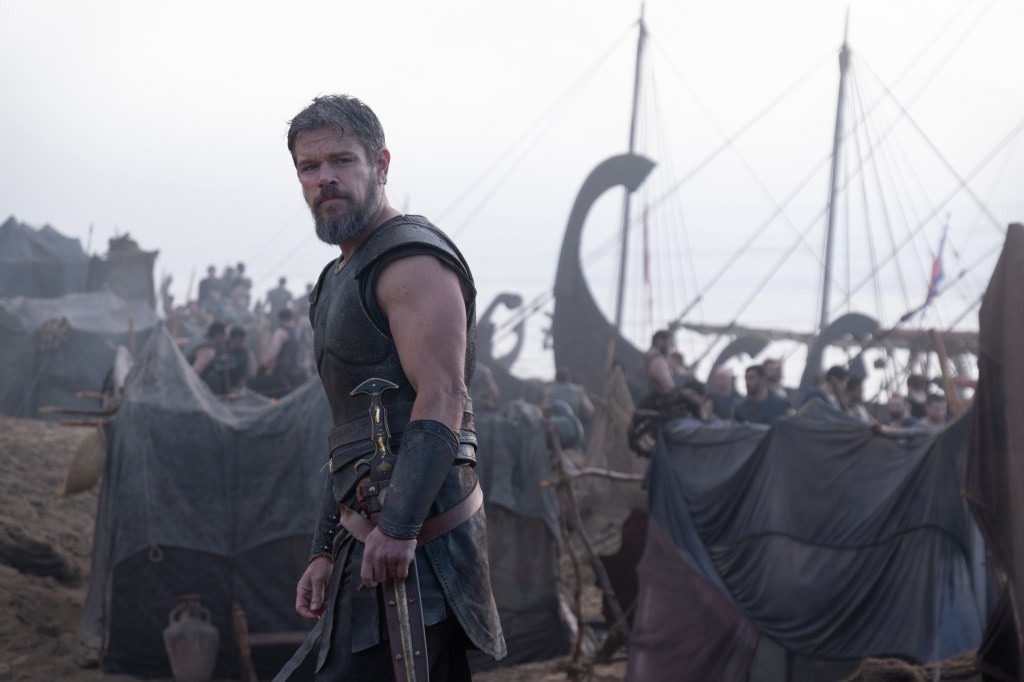
That said, no one eclipses Matt Damon as Odysseus. This is a bona fide movie-star performance in every sense of the phrase. Damon fully commits to the role physically, bringing a convincing weariness and hard-earned resilience that gives every action sequence tremendous weight. Yet it’s the emotional dimension of the performance that stayed with me most. He captures Odysseus’ guilt, exhaustion, and overwhelming longing for home with remarkable nuance and sincerity, grounding the film’s massive spectacle in something profoundly human. It’s one of the finest performances of Damon’s career and, for my money, one of his very best.
It almost feels excessive to keep piling on the praise, but what surprised me most is that I found The Odyssey to be one of Christopher Nolan’s most empathetic and spiritually resonant films ; arguably his most openly emotional work since Interstellar. Homer’s epic is, at its core, a story of redemption, forgiveness, and the long, arduous journey home despite the weight of past transgressions. Nolan’s screenplay wisely leans into the material’s spiritual and religious dimensions, exploring not only the devastation wrought by the fall of Troy but also the psychological and moral scars left by a lifetime of violence. This is ultimately a film about what war does to the soul.
If I had to distill The Odyssey down to its most compelling idea, it would be the perspective of the Greek gods – particularly Athena (Zendaya in this iteration), whose watchful presence hangs over the narrative as the gods wrestle with whether humanity has become irredeemable after the senseless brutality of the Trojan War. The fall of Troy is portrayed not simply as the defeat of one civilization, but as a turning point in which all of humanity risks forfeiting its moral compass, consumed by cruelty, vengeance, and endless bloodshed.
What makes Nolan’s interpretation so moving is that it refuses to leave the story there. While confronting humanity’s capacity for evil head-on, he remains steadfast in his belief that redemption is still possible. Odysseus’ journey home becomes more than a physical odyssey; it is a spiritual reckoning, one built on accepting responsibility for the past while choosing to move toward what matters most. There’s something profoundly moving in the idea that grace can still be found after unimaginable failure if one is willing to confront the consequences of their actions. Nolan realizes that idea with extraordinary conviction, culminating in a third act that delivers both an emotionally overwhelming payoff and some of the most exhilarating, crowd-pleasing filmmaking of his career.
All in all, The Odyssey is a staggering achievement. It feels like one of those once-in-a-generation films that arrives an instant classic; destined to be discussed, revisited, and adored for decades to come. Christopher Nolan has reached what feels like another creative apex, delivering the ultimate showcase of everything that has made him one of the defining filmmakers of his era. It’s difficult to imagine where he could possibly go from here, but I found myself asking the exact same question after Oppenheimer. Time and again, he somehow finds a way to surpass even his own towering accomplishments. As someone who loves cinema, it feels like a genuine privilege to witness a filmmaker operating at this level, and I can’t wait to see where his boundless ambition takes him next.



 Films for Breakfast
Leave a comment