
Casper Kelly has made a career out of carving out a very particular brand of horror that feels plucked from niche, nostalgic, public-access media. You certainly know him from his Adult Swim sketch that went mega-viral, Too Many Cooks. In many ways, his feature-length debut, Buddy, feels like the most natural evolution of his work as an artist – a feature-length extension, and almost a culmination, of everything he has made prior.
Buddy begins in a colorful world reminiscent of Barney the Dinosaur or Blue’s Clues. Buddy himself (voiced by Keegan-Michael Key) is a bright orange dinosaur who stars in his very own children’s television show. He teaches kids life lessons while helping them spend their days singing and dancing as they spread happiness. But when one child refuses to play along one day, Buddy isn’t pleased, and the cracks in both Buddy’s show and his character begin to show.
It should come as no surprise that Casper Kelly’s direction is one of the film’s obvious highlights. Even back in 2014 with his infamous Too Many Cooks, Kelly demonstrated an incredibly keen eye for visuals and an eerie, nostalgic yet deeply disturbing approach to analog horror. As Buddy begins, one of the most fascinating aspects of the film is how completely it commits to the idea of being a classic children’s television show for so long. The suspense naturally builds as you begin to wonder when (and how) things are finally going to go wrong. Kelly clearly has a lot of fun toying with expectations and, more importantly, the audience’s familiarity with these kinds of shows.
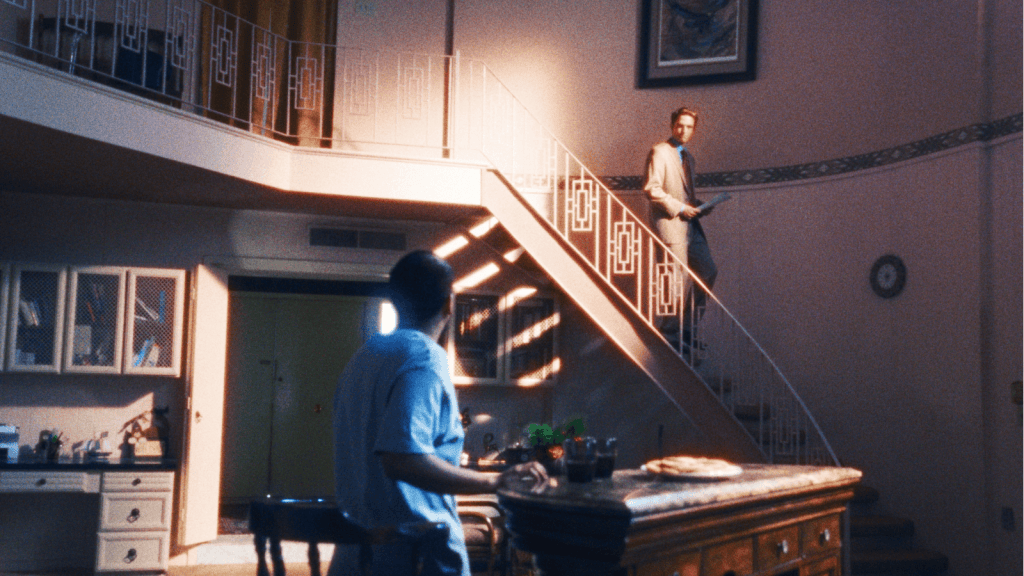
A huge part of why this works so well is the film’s impressive technical and production craftsmanship, particularly its production design. The set of Buddy’s world; from his house to the forest he explores and all of the spaces in between, is incredibly well-detailed and stylized. The puppetry is equally impressive, adding a tangible sense of charm and making this feel like a fully realized world beyond Buddy himself. There are genuinely likable characters inhabiting this strange little universe, which only makes the film’s darker turns more effective.
The costume design, especially Buddy’s practical suit, is also incredibly effective. It captures the look and movement of a ’90s children’s television costume; once again, think Barney the Dinosaur – while remaining incredibly dynamic as the film grows darker and weirder. Watching the suit gradually fall apart and mutate is both fascinating and deeply unsettling.
Going off the film’s practical costumes and puppetry, the voice work is also really solid. Keegan-Michael Key is excellent as Buddy, truly disappearing into the role and committing to the character’s ability to shift from an unpredictable force of infectious joy to something deeply frightening. Eric Bauza, Jimmica Collins, Michael Shannon, and Devon Hawkes Ludlow all deliver strong work in their respective roles, matching the excellent puppetry perfectly. But I have to give a particular shout-out to Patton Oswalt, who voices Strappy, the kids’ backpack. He was easily my favorite character in the film and, for me, the standout.
It feels like a rarity to praise child performances nowadays (and I say this without trying to be rude or dismissive) but it’s incredibly difficult for a young actor to give a truly great performance. They simply don’t have the experience that older actors have. But the kids in Buddy, across the board, really understand the assignment. I was particularly impressed by Delaney Quinn, who plays Freddy, the film’s central child character. She carries the film remarkably well and genuinely sells its more emotional and tense moments. She also has great rapport with Cristin Milioti’s character, who enters the larger picture later on.
If I have any real nits to pick with Buddy, they come down to some of its narrative decisions. For me, the film works best when it fully commits to the bit of remaining within the television-show format. There are certainly some cool ideas when it expands beyond that framework, but I do think the film loses a bit of its magic (and its terror) when it pulls back the curtain. I almost wish Kelly had allowed the film to live and die entirely within this space without ever breaking the fourth wall. That’s not to say these elements are completely without merit, but I simply don’t think they work quite as well as the more fantastical material.
At the end of the day, though, Buddy is simply an incredibly entertaining film despite some of its narrative shortcomings. Especially for a feature-length debut, it demonstrates an enormous amount of promise for Casper Kelly behind the camera. I can easily see this becoming a cult favorite, or even finding surprising success at the box office thanks to its mysterious marketing and effective twists and turns. It isn’t perfect, but Buddy represents a lot of what independent filmmaking is all about.



Leave a Reply