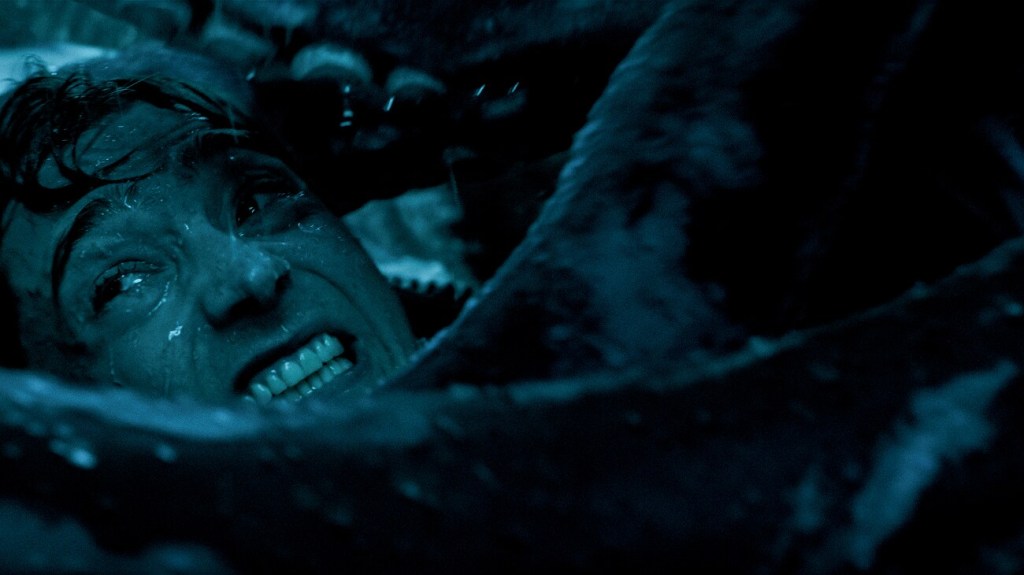
You’d be forgiven for expecting Whalefall – a movie about Austin Abrams once again having the worst day in human history, this time after getting swallowed by an 80-foot, 60-ton sperm whale – to be hokey. As the marketing has ramped up, heavily emphasizing the 4DX experience of it all, I was bracing myself for an all-thrills, no-frills experience. I’m all for these types of films, provided they have the visual ingenuity to match their premises and use their thrills to maintain a compelling, breakneck pace.
And yet, as I sat in a Dolby auditorium for my press screening of Whalefall, I was met with a surprisingly somber first act. The film opens with Jay (Austin Abrams) at the very beginning of his grieving process following the death of his father, Mitt (Josh Brolin), with whom he had a complicated relationship. I was surprised to find that the first 20 minutes or so primarily focus on Jay’s family dynamic, lingering on the complicated feelings that arise when someone who was never quite the person you wished they’d be is suddenly gone.
One smaller detail I appreciated was how Jay struggles to relate to his sister’s grief. She saw a side of their father that he never did (a softer side) while Jay seemingly got the brunt of his father’s criticism as Mitt attempted to mold him into a capable person who was simultaneously as prepared for the world as he was and radically different from him.
It’s this push-and-pull dynamic between father and son, coupled with the mystery of how their relationship went so badly off the rails, that gives Whalefall a surprisingly compelling emotional edge right out of the gate. Credit is also due to the conceit of the original book, which I haven’t read: Jay’s reason for putting himself in this situation is that he wants to find his father’s remains in the ocean.
The film establishes that Jay is fully aware of how reckless this undertaking is, making a convincing case for the absurd circumstances he finds himself in. He’s clearly not in the best headspace when he ventures into the water in the first place, and his decision feels rooted in the emotional turmoil he’s experiencing rather than simply serving as an excuse to get the plot moving.
Austin Abrams is clearly having a moment right now, and for good reason! Whalefall is yet another impressive showcase of his charisma and dramatic chops. He plays the everyman exceptionally well, and while Resident Evil managed to sprinkle in moments of humanity beneath the relentless pace Zach Cregger cooked up, I was impressed by how Whalefall gives Abrams an almost entirely solitary showcase for his talents. The caveat is that a large portion of the film requires him to react to increasingly painful and upsetting circumstances, often with an oxygen mask covering his face. And yet, his performance still manages to shine through.
Director Brian Duffield deserves some flowers for his work here. His last film, No One Will Save You, hit a very similar chord for me: I found some of its plot and character mechanics equally frustrating and engaging, yet its technical filmmaking was consistently innovative and invigorating. Duffield has a keen eye for making the inside of the whale feel just as claustrophobic for the audience as it does for Jay, which often makes for an upsetting experience. But given the kind of film he’s making, I really appreciated this approach. Go hard or go home.
On a technical level, I found the VFX and production design truly excellent across the board, ranking among the best I’ve seen this year. There’s a remarkable balance between tangible sets, clever visual tricks, and seamless VFX integration that makes Whalefall a genuinely impressive audiovisual experience. The cinematography from DP Aaron Morton is especially striking; the way he captures the interior of the whale is downright stunning at times. A sequence in which Jay uses a jellyfish as a light source, along with the way he illuminates the more acidic areas of the whale’s stomach, particularly impressed me. Meanwhile, the vastness of the surrounding ocean reinforces Jay’s isolation and his fear that he may never be rescued. Without spoiling too much, a key sequence involving beluga whales and sperm whales is downright gorgeous.
Where the film flounders a bit is in its flashbacks. I found the editing precise, with the transitions in and out of the past effectively woven into the story without sacrificing the tension of the present. That said, for a film so reliant on (and fundamentally built around) the complicated relationship between a father and son, a handful of these sequences don’t quite land. Abrams and Brolin both deliver solid performances, but the script can feel ham-fisted, leaning on overwritten dialogue that spells out emotions better left unspoken. The film works best when it allows these two men to communicate through their performances and the feelings lingering beneath the surface. It works least when it feels the need to have them articulate everything outright.
Compared to the visual ingenuity of the whale sequences, the flashbacks simply don’t measure up. Some of the dialogue feels hokey, and the film occasionally falls back on familiar grief-storytelling tropes, including the obligatory unopened letter from the deceased. There’s plenty to poke fun at here, particularly given how many thrillers and horror films about processing grief have recycled these same conventions. Whalefall is hardly immune to the clichés and on-the-nose writing that have become commonplace in the genre.
That said, I appreciated how the film begins to move away from its flashbacks as it enters its final act and, without spoiling too much, ventures into territory that’s far more cerebral and spiritual than I anticipated. These elements give way to some surprisingly emotionally honest and genuinely powerful moments that make the third act hit harder than the first two. Without giving anything away, I also thought the conclusion struck a satisfying balance between delivering on the film’s blockbuster ambitions and bringing its emotional journey to a meaningful close.
For all its faults, I have to champion a mid-budget film that looks this good and stretches its resources as far as they possibly can go. There are certainly clichés and on-the-nose writing galore, but Whalefall strikes a rather appealing balance between popcorn entertainment and deeper emotional resonance, something that feels increasingly rare in major studio filmmaking today. For those reasons alone, it’s well worth venturing out to the theater for. See these kinds of films while they continue to make them.



Leave a Reply