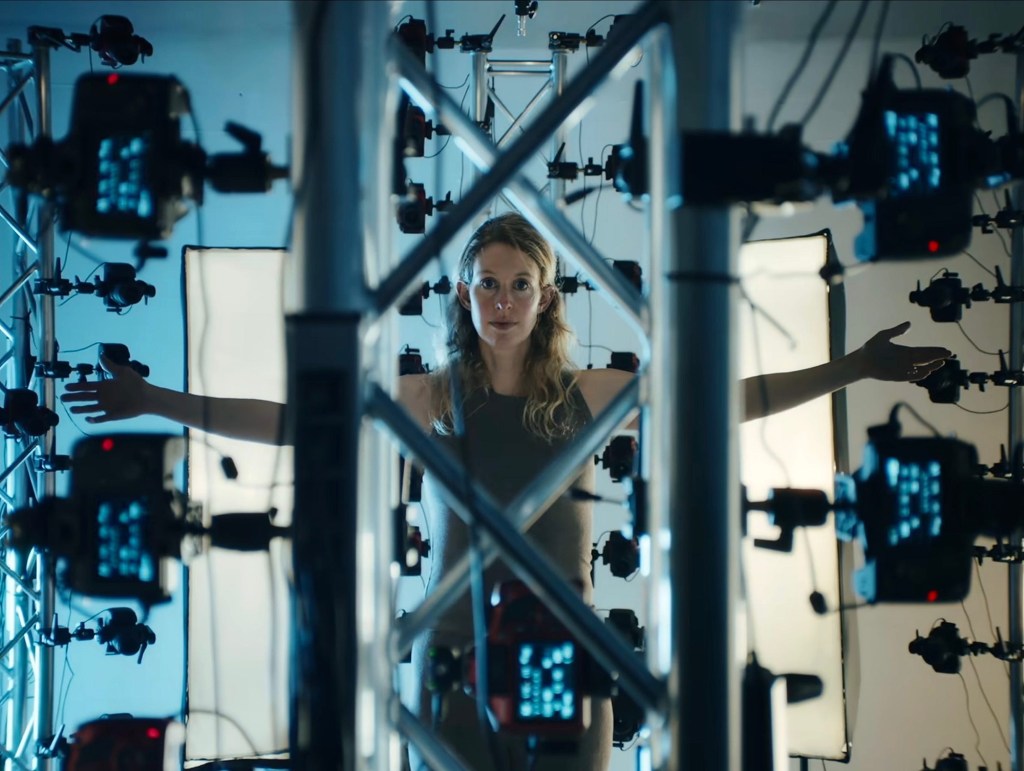
I truly can’t remember the last time I saw a film that made me immediately want to write about it. I don’t want to sit with it and process my feelings internally just yet; I want to capture them as authentically as possible while they’re still fresh, right out of the theater, because I know I’ve seen something special that will linger in my mind forever. You Can See Everything just might be the best film I’ve seen in 2026 so far, as well as one of the very best films of the decade.
I almost have so much to say about this film that I’m struggling to believe I’ll be able to articulate everything I felt while watching it in one sitting. It feels like the kind of work that I could spend a lifetime writing about and still find something new to say. Inevitably, I will read this back tomorrow and pinch myself because I forgot to discuss a certain scene. With that in mind, if you haven’t seen the film yet, please watch it before reading any further. This is a work of art best experienced knowing as little as possible.
Thirty-four days before she’s sent to prison, Elizabeth Holmes invites Nathan Fielder into her family’s home to make a documentary about her life in the lead-up to her imprisonment. From the very beginning, without much in the way of setting the stage, we’re thrown into the middle of everyday life with Elizabeth Holmes: the woman we’ve read countless articles about, watched get ridiculed, and seen torn to shreds by countless people. And yet, almost immediately, she’s framed in an entirely organic light. As a mother and a wife, she’s simply a woman preparing to say goodbye to her family. Within the confines of this space, she’s forced to confront the reality of her situation without the baggage that has long accompanied her public image.
Juxtaposed with this intimate view of Holmes’s day-to-day life, we see Nathan Fielder prying away behind the camera. As the film unfolds, it genuinely feels as though he’s trying to make sense of both the reality of the opportunity before him and the angle he might pursue, piecing things together as he goes along. I could be wildly off-base in this assumption, but the entire first half of the film feels like Nathan knowingly stepping into a minefield, fully aware that anything could happen. In the hands of Fielder and co-director Lance Oppenheim, the result is a soaring portrait of incisive questioning, investigative curiosity, seamlessly woven humor, and perplexing bursts of raw emotion. It’s unlike anything I’ve ever seen, and I doubt I’ll ever see anything quite like it again.
The first half of the film is largely what I expected it to be, albeit perhaps frontloaded with more emotional depth than I anticipated. And there’s nothing wrong with that. Elizabeth Holmes is an innately fascinating figure, regardless of how much exposure she’s received over the years. Watching her navigate everyday life with her partner, Billy Evans, quickly becomes a central focal point of this section of the film. With the exception of a handful of moments, almost every time Fielder attempts to get a deeper understanding of Elizabeth, Billy finds his way into the frame and cuts the conversation short.
There are two moments in particular involving Billy during this first act that completely floored me. The first, and one you’ll likely see referenced frequently in conversations about this film, is a sequence in which Nathan attempts to speak with Elizabeth in their kitchen as she beats a bowl of eggs. Billy abruptly steps into the frame, visibly frustrated, and takes the bowl from her to do it himself. Fielder, with incredible instincts and impeccable timing, immediately probes Billy about why he felt the need to do that. The two ultimately brush off the interaction, but the tension surrounding Billy’s involvement in both the project and Elizabeth’s life never quite dissipates from this point forward.
The second moment finds Elizabeth’s parents visiting the home to spend time with their daughter before she leaves for prison. Nathan and her father, Christian Holmes, begin discussing Elizabeth’s life and her struggles in remarkable detail. He speaks about her abusive past relationships and the fact that she was sexually assaulted, all while fighting back tears as he tries to articulate just how much he loves his daughter. You could hear a pin drop in my theater during this sequence. It’s sincerely devastating, but it also feels as though the film is breaking entirely new ground in its willingness to explore Elizabeth as a human being who has endured immense trauma. And just as the emotion begins to reach its breaking point, Billy enters the frame and asks to cut the conversation short so the family can have some time together. Throughout these interactions, Nathan repeatedly asks Billy whether he’d like for him and the crew to leave. Billy largely avoids giving a direct answer, all while making his discomfort with their presence increasingly apparent.
By this point, the film has become a monumental moral conundrum. Beyond the investor fraud and various legal charges Holmes faced, Theranos was responsible for profound moral and medical failures that affected countless people. And yet, as Fielder speaks with her, something begins to take shape. Maybe not quite a bond, but a reluctant sense of care for another human being that I don’t think I’ve ever seen quite like this from him as an artist. Fielder is one of our very best at finding the perfect angle from which to both laugh at and understand real people who seem larger than life. But as the film unfolds in real time, it feels as though he’s increasingly confronted with a series of inescapable moral dilemmas of his own.
There’s an unshakable suspicion that he’s being played, that Holmes is withholding the truth from him. And yet, there’s also raw, unfiltered emotion. Holmes seems to reveal an immense degree of emotional vulnerability with Nathan, and for someone who has been branded as entirely heartless, she has no apparent hesitation in breaking down in front of the cast and crew when confronted with the reality of all the time she’s about to lose. It’s incredibly thorny material, captured with such an organic intimacy that you almost feel as though you shouldn’t be watching it.
Another highlight sequence, one that both perplexed me and left me deeply saddened, features Fielder showing Billy and Elizabeth Abbott and Costello’s classic Who’s on First?routine. Fielder watches from behind Elizabeth as she observes one of the most famous comedy routines of all time, offering little more than a grin. When it ends, he asks her whether she found it funny and whether she can explain to him why it works as comedy. She struggles to connect the dots of what makes this very literal routine amusing, though she maintains that she enjoyed it. Billy, once again, interjects to suggest that this is simply further proof that Elizabeth is special and sees the world differently from the rest of us.
Throughout much of the remaining time Fielder spends with the family, there’s an increasingly heavy emphasis on Holmes’s mental state. She appears to be experiencing profound dissociation, seemingly drifting in and out of herself at almost any given moment. When you begin to look past everything you think you know about her and allow the film to speak for itself, it’s genuinely heartbreaking. Another particularly tender moment finds Fielder attempting to show Elizabeth and Billy Hulu’s The Dropout, featuring Amanda Seyfried’s Emmy-winning performance as Holmes. Elizabeth becomes visibly upset by the show’s seemingly heightened dramatizations of her life and traumas, eventually turning away from the screen before Billy asks Nathan to turn it off.
As the clock counts down to Elizabeth’s first day in prison, the film truly skyrockets, building an almost unbearable degree of emotional turmoil and dramatic tension. Just before Nathan and Elizabeth say goodbye, an awkward moment unfolds outside the car, lingering far longer than you’d expect but ultimately serving as perhaps the film’s most illuminating encapsulation of their relationship. Nathan never quite lowers his guard enough to call her a friend, but for a brief moment, you genuinely wonder whether the two are going to hug before she gets into the car. Instead, they’re left awkwardly staring at one another, with neither quite knowing how to navigate the moment. Fielder, like the audience, is left grappling with deeply conflicted feelings of empathy and suspicion toward Holmes just before she disappears from the frame for nearly the remainder of the film.
Enter the most exciting hour or so of filmmaking I’ve seen this decade. As the film jumps forward from 2023 to 2025, I was genuinely left wondering: Where the hell could they possibly go from here? The very first shot tells you everything you need to know. Billy is firing away at a gun range in Texas, a far cry from the man who spent the first half of the film hovering over nearly every interaction in his family’s home. There’s an eerie undertone to this section of the film, as Billy seems to have become even more aggressive and assertive in Elizabeth’s absence. With her in prison, he has been given free rein over her “legacy” and their family, all while continually interjecting during Nathan’s interviews in much the same way he did when Elizabeth was still at home.
On top of this, the backdrop of Theranos seemingly relaunching with an AI-generated Elizabeth Holmes as its mascot sets an especially grim tone. There’s something deeply unsettling about watching the machinery of her public image continue to operate, even as the woman herself has been removed from the equation.
And yet, before we can spend too much time getting reacquainted with Billy and his everyday life, we’re hit with an abrupt close-up of Amanda Seyfried’s face. It’s perhaps one of the most shocking reveals I’ve ever seen in a major motion picture. I’ll try not to spend too much time recapping the major moments of this section, but the incredible shot of Amanda Seyfried watching footage on Nathan’s laptop of Elizabeth Holmes watching Seyfried portray her in The Dropout is one of the most mind-bending yet deceptively simple things I’ve seen in ages.
Her role also unlocks an endlessly fascinating metatextual angle to the film: the experience of real people watching fictionalized versions of themselves onscreen. The film makes a point of emphasizing that a significant majority of people who know who Holmes is only know her through the Hulu series, and the idea seems to eat away at Elizabeth from the inside. But, as with so many things in this film, Seyfried offers a compelling counterargument: It isn’t an actor’s responsibility to educate an audience or ensure that every detail is 100% factual. There are consequences to Holmes’s actions, and the public’s perception of her would likely be much the same with or without the series. And she’s right, too!
Enter Christopher Abbott as a stand-in for Billy, as Fielder decides to recreate his first meeting with Billy, Lance Oppenheim, and the A24 executives. In a very The Rehearsal-esque sequence, Fielder attempts to reconstruct how Billy tried to convince A24 to allow both him and Elizabeth to profit from the film. Fielder, of course, argues that the integrity of the project would immediately come into question if they were financially compensated, but Billy continually brushes off his concerns. Shortly afterward, we learn that the deal was ultimately made, introducing an underlying tension that makes you wonder whether a percentage of the ticket you purchased is now sitting in Billy Evans’s pockets.
The film, almost in real time, beautifully transforms from a portrait of Elizabeth Holmes’s life in the lead-up to her prison sentence into a joint investigation of sorts between Seyfried and Fielder. In perhaps the most riveting sequence in the entire film, Amanda and Nathan join Billy for dinner, where, for lack of a better phrase, all hell breaks loose. What begins as a relatively cordial conversation quickly dissolves into Seyfried taking everything she knows about Billy and running with it. She makes it abundantly clear that she believes he’s a narcissist, and the conversation spirals from a brief debate about Charlie Kirk into an absolutely shocking revelation: Billy not only controls Elizabeth’s social media accounts, specifically her X/Twitter account, and posts on her behalf, but also holds power of attorney over her. The two clash in a way that culminates in Billy revealing that he has the resources to harm other people. And just as Amanda begins probing him about this admission, Billy shuts the conversation down.
Hilariously, and perhaps wisely, Fielder remains completely silent throughout this entire exchange. He sits awkwardly between the two of them, reacting to the revelations as they unfold while fully aware that he shouldn’t dare interfere with what is happening so organically in front of him. Before they even arrive, Seyfried tells him that her presence is important because people, particularly men, will respond differently to her than they will to Nathan. It’s for this very reason that her inclusion in the film feels so invigorating and monumental every time she appears on screen.
Seyfried’s role here is remarkable. She is clearly presented as herself, while also fully inhabiting the role of Elizabeth Holmes once again. I especially appreciated her acknowledgment that she may have some regrets about how certain things were portrayed in The Dropout, without ever fully disavowing the work itself. She seems to have developed a deeper sense of empathy for Elizabeth and a greater willingness to question who she is as a human being. That perspective naturally bleeds into the sincerity of her performance here, making it fascinating to see how differently she approaches the character just a few years later.
I’m going to try to move away from directly recapping every standout moment in the film and focus instead on how its third act made me feel, because there are simply too many moments to count. I found the film’s central exploration of empathy for Elizabeth particularly compelling, especially in the way it manifests through Nathan’s desperation to contact her while she’s in prison. He becomes increasingly determined to speak with her privately, without Billy present, out of a growing fear that Billy may be exploiting Elizabeth and taking advantage of her circumstances. Before this tension even fully comes to a head, Amanda lays out the central dilemma perfectly: Either Elizabeth is the most cunning sociopath in the world, and they’re being played all over again, or their suspicions about Billy are true, and she desperately needs someone to intervene. Both possibilities make for some wildly compelling filmmaking.
As the film begins to wind down, it takes a turn I wasn’t quite expecting. Fielder attempts to recreate his final visit with Elizabeth in prison alongside Seyfried, and a lingering question begins to emerge: Has Nathan’s growing empathy, attachment, and genuine concern for Elizabeth compromised his ability to remain objective? Where he began as the perfect lens through which to explore the otherwise unknowable world of Elizabeth Holmes, armed with his unique ability to illuminate the most unlikely people and situations, he eventually reaches a breaking point. The familiar Nathan Fielder persona we’ve come to know from television no longer feels entirely present on screen. Instead, we’re witnessing something closer to the real Nathan Fielder, or at least a version of him: someone visibly upset and frustrated by the complexities of the situation, the ethical dilemmas he finds himself navigating, and the very literal roadblock that Billy has become.
The tension between subjectivity and objectivity is fascinating here. The idea that Nathan may have become so emotionally invested in Elizabeth’s well-being that he can no longer recognize the potential signs of manipulation feels like the perfect breaking point for the film. Every documentarian wants to remain impartial toward their subjects, but storytelling is inherently rooted in humanity. We’re drawn to these stories because we’re human, and that same humanity makes us susceptible to manipulation. We can never fully escape our own biases, nor can we ever be entirely certain that we’ve uncovered the complete truth. The story of Elizabeth Holmes is a never-ending Rubik’s cube, one you can spend a lifetime trying to solve without ever quite getting it right.
As the film concludes with a lingering dual image of Elizabeth behind prison gates, playing with her family, and a flashback to her and Nathan smiling together in the ocean, you’re overwhelmed by the possibility that this may be the closest we will ever come to understanding her as a person. And even then, we may still feel wholly unsatisfied by how much remains unknown. But how could we ever expect otherwise? To view her solely as the criminal founder of Theranos is to negate the humanity beneath that image. Conversely, to see only the good in her is to overlook the immense harm she undeniably caused. Both truths must coexist, however uncomfortable that may be.
Now, just a few hours removed from seeing the film, I wish I could wrap up my thoughts with a nice, neat bow. But I’m much more interested in how conflicted I feel about the entire experience. This film took me on a journey through the ethics of investigative journalism and documentary filmmaking while offering a searing portrait of an incredibly public figure you may once have believed you hated. It asks you not necessarily to understand her, but to at least acknowledge her humanity.
You can see everything, but at the end of the day, “everything” is still limited to everything you’re able to see. There will always be something missing, perhaps the one pivotal piece of information that could completely reshape your understanding of the situation. There is always the possibility that the most important truth is the one being withheld from you. The film never settles on one grand thesis statement or attempts to tie everything together into a definitive conclusion. Instead, it allows everything that came before to speak for itself. And perhaps that’s all you can do when your own sense of objectivity may have been compromised.



Leave a Reply